The choice between a hand-operated rooflight and an electric one starts with a tape measure and a pair of shoes. Stand in the room, look up at where the opening part will sit, and ask whether you could open and close it without a ladder. Everything else, from a landing to a loft bedroom, follows from that answer.
Manual is the simpler product when the answer is yes. Electric earns its place when the answer is no, or when a person in the household cannot easily lift an arm to a catch. This guide takes the decision in the order it usually arises, and ties it back to the Welsh Building Regulations where they have something to say.
Begin with reach
An opening part is only useful if somebody can work it. Over a bathroom, the window can sit above a bath, a shower tray or a basin, and the person opening it may be wet, wrapped in a towel or standing on a slippery surface. Over a kitchen worktop, a rooflight can sit behind a hob or beyond a deep run of units, which puts the catch further away than the ceiling height suggests.
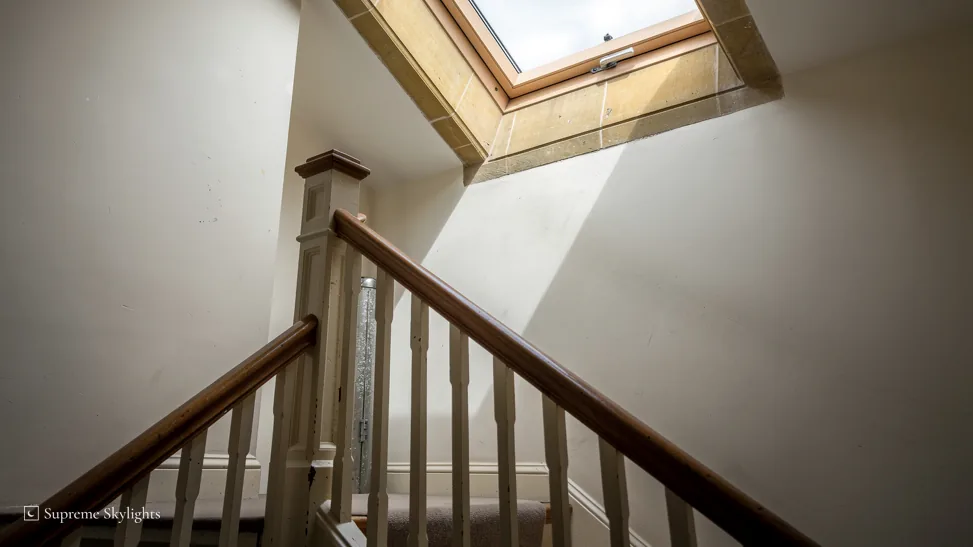
Over a stairwell the problem is plainer. The opening part may be several metres above the nearest floor, with a drop below it, and nobody should lean over a banister to reach a handle. A high ceiling in an extension is the same case in a different room. These are the positions where a motor stops being a luxury and becomes the way the unit gets used at all.
When the opening part is within an easy arm's length from a safe place to stand, a hand-operated unit does the job with nothing to power.
| Room | Where the opening part sits | Leans towards |
|---|---|---|
| Bathroom roof window | Over a bath, shower or basin | Electric, if the catch is out of a dry reach |
| Landing or stairwell | High, with a drop beneath | Electric |
| Loft bedroom | Within reach of the bed or the floor | Manual, or electric for ease |
| Kitchen extension | Over a worktop or an island | Depends on the distance across |
| Utility or boot room | Low ceiling, near the door | Manual |
Think about the person using it
Reach is a matter of the room. Use is a matter of the household. A rooflight that one adult opens without a thought may be a daily obstacle for another who has a limited grip, a stiff shoulder or a bad back. A motor turns the job into a press of a control, and a hand-operated unit asks for a lift, a pull or a push at arm's length.
It is also worth thinking about the order of the day. A bedroom is opened in the evening and shut at first light, by someone who may be tired. A kitchen is opened mid-cooking with greasy hands. A room used by visitors, such as a guest bathroom, is opened by people who have not met the unit before. In each case a simple action wins, and a motor gives the simplest action available once the opening is out of reach.
Rain, forgetting and the evening
A hand-operated rooflight stays exactly where it was left. Open it on a warm afternoon, go out, and it is still open when the weather turns. That is a matter of habit for some households and a worry for others.
VELUX states that its solar and electric roof windows come with a built-in rain sensor, and that the sensor shuts the window by itself once rain arrives. That feature is VELUX's, on those windows. A manual unit has no rain sensor and stays as it was left. For any other electric product, ask for the specification instead of assuming.
Evenings bring a different habit. A loft bedroom in June can be left open as the light goes, and the glass turns black and mirrors the room while the air moves. Closing it before bed is easy with a motor and a small climb with a hand-operated unit.
A motor suits the opening you cannot reach, and a hand-operated unit suits the one you can.
Room by room
Bathrooms
A bathroom wants an opening in the roof for steam and damp. The window is worked by someone who may be barefoot and damp, so a position directly above the bath or shower is the one to treat with caution. If the catch is only reachable by stepping onto the bath edge, a motor is the safer answer.
Bedrooms under the roof
A loft room is where the roof window sits closest to the bed and the floor, which suits a hand-operated unit well. The evening matters here: a window opened for air on a June night is also a black mirror once the light goes, so some households like the ability to close it from the pillow.
Landings and stairwells
Here the opening part is hard to reach at all. The distance, and the drop below, make the case for a motor without further argument.
Kitchens and extensions
A flat-roof rooflight over a kitchen at supper time is a good place to open for air, and the question is how far the opening part is from the worktop edge. A wide extension can put it beyond a comfortable stretch even where the ceiling is not high.
The two side by side
Cost, controls and power are the practical differences, and cost is quoted only after a survey. The panel below sets the plain facts out. The cost of an electric unit has a separate page, how much an electric rooflight costs, and our costs overview covers the whole range.
Opened by hand
- Works when the opening part is within reach from a safe spot
- Stays as it was left until someone returns to it
- Asks for no power supply
- Needs nobody to learn a control
Opened by motor
- Suits an opening above a stairwell, a high ceiling or a bath
- Opens and closes at the press of a control
- Needs power, which for VELUX comes as either a solar or an electric version
- VELUX fits a sensor for rain to its solar and electric roof windows
What the Welsh regulations treat the same
Approved Document L (Wales) sets figures by type of unit, so a roof window should be no worse than 1.4 W/m²K or Window Energy Rating Band B, and a rooflight no worse than 2.2 W/m²K, whichever way the opening part moves. Fitting a window, roof window or rooflight is building work, and a new rooflight will generally need approval from a building control body. Where the work is notifiable, we handle the Building Regulations notification with local authority building control or a registered building control approver. The detail is in the companion guide on Welsh regulations for electric opening rooflights.
Ventilation is where the two types meet the guidance differently in practice. Approved Document F (Wales) lets an opening window provide the quick airing each habitable room needs, so the angle the opening part reaches counts, and where a replaced window had trickle vents, the new ones should be no smaller and controllable by the occupant or automatically. A motor can be the way a hard-to-reach opening gets used at all, which is a practical point and no regulatory one.
When the window is also the way out
In a loft bedroom the roof window may have a second job. Approved Document B (Wales) treats an escape window as one with an unobstructed opening of at least 0.33 m², at least 450 mm high and 450 mm wide, its bottom edge no more than 1,100 mm above the floor. The person must be able to reach a safe place from it. The document adds that the window should stay open without being held. In a roof window the bottom of the opening may be 600 mm up, in place of the usual 800 mm guarding height.
Hand-operated and motorised units alike are measured against those figures, and the check belongs to the specification. If you plan a loft bedroom, mention it at the survey so the unit chosen suits both the daily air and the escape question.
Pitched slope or flat roof
The decision looks a little different depending on the roof. In a pitched slope, a unit set in the same plane as the tiles or slates is a roof window, and the opening part can sit at head height or above. In a flat roof the unit is a rooflight on a kerb, and the opening part can be an arm's length above a hob or a dining table, or far above a staircase.
If the unit never needs to open at all, a fixed one removes the question. Our guide to fixed or opening flat rooflights covers that case, and the answer on getting a skylight that opens explains the options. How the power reaches an electric unit is dealt with in how an electric rooflight is powered.
Five questions to settle it
- Stand where the opening part will be Can you reach it from a safe place without a ladder?
- Name the person who will open it Think of the least tall and the least strong person in the home.
- Picture the end of the day Who closes it, and when?
- Check for a power supply A motorised unit needs one, mains or solar.
- Ask for the specification Look for the rain sensor, the opening angle and the glazing figures.
Settling it at the survey
The free survey is the place to decide, because the roof, the room and the people in it can be looked at together. We install and replace opening rooflights of both types, and a fixed written quote follows the survey. The survey is free, and it comes before any price is given. Our 10-year workmanship guarantee is in writing.
At the visit we look at how high the opening part will sit above the floor, what else in the room can be opened for air, and what the old unit had for background vents if one is being replaced. Those three details can settle the question between hand and motor before a product is named. It is also the moment to mention anyone in the home who finds high or stiff catches difficult.
Start with the electric opening rooflights page, then use the quote form to book.