Misted rooflights in Newport
Misted rooflights and skylights across Newport, glass replaced after a free survey.
- 10-year workmanship guarantee
- We handle the Building Control notification where notifiable


Mist that sits between the panes is still there when the lamps go on and the glass turns black.
Wiping does nothing, because the cloud is inside the sealed unit. The survey decides between new glass and a whole new rooflight, and good after dark covers how the glass behaves in the evening.

- Symptom
- cloud or droplets between the panes
- Route
- a new sealed unit, or the whole rooflight
- Checked
- frame, flashing, upstand and lining
- Glazing
- double or triple, matched or upgraded
- Rules
- Welsh Building Regulations considered
- Guarantee
- 10 years on workmanship, in writing
Reading the mist at first light
Cloud between two panes looks different from damp on the room side, and the difference decides what happens next.
Early morning is the best time to look at a rooflight you suspect of going cloudy. Low sun lights the whole sheet of glass from one side, and every smear, bead and milky patch shows. A misted rooflight carries its cloud between the panes, and that cloud stays put whatever the weather does outside.
The reason sits in how the glass is built. Double and triple glazed rooflights and roof windows use sealed units: two or three sheets of glass held apart round the edge by a spacer, with a seal closing the gap between them. When that seal fails, damp air can get into the gap and condense on the inner faces of the glass. Nobody can reach those faces with a cloth. Wiping the inside or the outside of the rooflight changes nothing, because the cloud is in the middle of the unit.
Plenty of other things look similar at a glance, so it helps to sort them out before booking a visit. Moisture on the room side of the glass usually comes from the room itself: a kitchen with a boiling pan, a bathroom after a shower, a landing with washing drying nearby. That kind comes and goes with the day, and it wipes off. Grime, pollen or a green film on the outside face wipes off too, though a flat rooflight can be awkward to reach. Mist between the panes does not move, and it can look worse on a cold morning, then thin a little as the day warms.
Some units can fail slowly, with a faint haze in one corner for a season before cloud spreads across the pane. Others can show the whole thing at once. Neither pattern tells you much about the roof itself, and a photograph settles little. The visit is where it gets decided.
| What you see | Where it sits | What it tends to mean |
|---|---|---|
| Cloud or droplets that stay all day | between the panes | the seal of the unit has probably failed |
| Beads of water that wipe off | room side of the glass | damp air in the room |
| Green film or dirt | outside face | weather and time |
| Stain or drip near the frame | lining or ceiling | water getting in at the roof junction, a separate check |
A wet patch on the ceiling lining, a stain around the frame or a drip after rain is a separate question from a cloudy unit. It can point to water getting in at the junction between the rooflight and the roof, and the survey looks at that as well. A misted unit on its own does not mean the roof is letting water in.
Loft bedroom roof windows, bathroom roof windows, flat rooflights over kitchen extensions and lantern glass can all be glazed with sealed units, and any of them can then mist. The table sets out the common sightings against what each tends to mean.
Before you get in touch, a few notes make the visit more useful: the room the rooflight serves, whether it is a roof window in a sloping roof or a rooflight standing on a kerb in a flat roof, how many panes show the cloud, and, for a VELUX, its size code. The next chapter says where to look. Our guide on what can be done about a misted rooflight goes through the options before a survey is booked.
A free survey on the roof and in the room
First we find out what is actually fitted, how big it is and what surrounds it.
A free survey always comes first, ahead of any price. With a misted rooflight, the opening job is identification. A pitched roof window, a rooflight on a kerb in a flat roof and the glazing of a lantern over an extension are three different things, and each has its own sealed units, its own fixings and its own way of being replaced.
On a VELUX roof window the identification is quick. VELUX publishes a size table in which MK04 is 78 by 98 cm, MK06 is 78 by 118 cm and UK04 is 134 by 98 cm. Each window carries a type sign, a small metal label on the top of the sash that you can read once the sash is opened, and VELUX says every window made after 1968 has one. The code printed there gives the width and the height, which is most of what is needed to know what is fitted. Our page on VELUX size codes covers reading them, and a separate answer looks at swapping only the sealed unit in a VELUX.
Next we measure the unit itself, because a sealed unit is made to one size. The thickness of the glazing, the depth of the frame and the way the unit sits in it all matter when a new one has to fit the old frame. We also look at the frame, since a new unit that goes into a tired frame leaves the next problem waiting. For a flat rooflight, we look at the upstand and the way the roof covering turns up it. For a roof window, we look at the flashing round the frame and at the lining inside.
What the survey records
- Type
- roof window, kerbed rooflight or lantern glass
- Size
- unit measured, VELUX size code noted
- Frame
- condition, and what it will take
- Surround
- flashing, upstand and lining
- Room
- use by day and at night
- Outcome
- a fixed written quote
The room comes into the survey too. A rooflight over a bed, over a bath or over a table asks different things of the glass. In a loft bedroom it may be a question of blinds and early light. In a kitchen extension it may be summer heat. Clear glass is replacing cloudy glass, so what you want from the opening is worth saying out loud while we are there.
Afterwards a fixed written quote follows.
Areas covered from Newport
Misted skylights are surveyed and replaced in homes within 30 road miles of Newport, the city at the centre of the patch. Welsh addresses include Caerleon, Cwmbran, Caerphilly, Chepstow and Cardiff. Across the Severn the work reaches Bristol and parts of South Gloucestershire, which follow England's planning and building rules. Every town is on the areas page.
New glass, or a whole new rooflight?
Both routes are real, and which one suits depends on the unit, the frame and the age of the rooflight.
There are two routes for a misted rooflight, and neither is the default. The first is a new sealed unit set into the frame already there. The second is taking out the whole rooflight and fitting a new one in its place. The survey exists to tell them apart.
Changing the glass alone is the lighter job. It suits a rooflight whose frame is sound, whose flashing or upstand is in good order and whose glazing can be matched. A new sealed unit is made to the measured size, so whether it is available as a separate part for a given make and age of rooflight is one of the things we find out. Some older rooflights can make glass-only work awkward, and a maker's range can change over the years. Where a glass-only job is possible, it is the route discussed first.
Replacing the whole rooflight makes sense when the frame has seen better days, when the surround needs attention anyway, or when the existing unit is single glazed and the household wants a better one. It is a bigger job and it opens the roof around the unit, so the Building Regulations and, in a few situations, planning come into it. Both are covered in the chapter on the Welsh rules.
The condition of the frame often settles the question. A frame that opens and closes well, with seals that still press, is a good home for a new unit. A frame that has warped, discoloured or begun to show gaps at the corners is a poor one. A lantern frame can be made to measure when a whole new one is called for, and if aluminium frames and uPVC are both available for it, the material is picked at survey.
The two routes
- LookSurveyUnit, frame, flashing and room checked.
- Route ANew sealed unitGlass made to size and set into the frame already there.
- Route BWhole rooflightOld unit and frame out, new rooflight in, surround dressed.
- ResultFixed written quoteGiven once the survey is done.
The roof around the frame counts as well. If the flashing has lifted or the upstand finish has opened up, those are looked at on the same visit, because the aim is a weatherproof, watertight finish round the new unit. A new unit in a doubtful surround gives the next problem somewhere to start.
Any price waits until the roof has been seen. Our guide New glass or a new rooflight compares the two in more detail, and the cost of a misted rooflight looks at what moves a quote in either direction.
Whichever route is chosen, the new work carries a 10-year workmanship guarantee, given to you in writing. The details are on our guarantee page.
Choosing the replacement glass
Matching what was there, or taking the chance to change it.
Early afternoon is when the decisions about glass get made, because a new sealed unit is a made-to-measure item and its specification is chosen before it is ordered. The simplest choice is to match what is there. The other is to use the replacement as a chance to improve the glazing.
Double or triple glazing is the first question. For VELUX flat and curved glass rooflights, the maker offers double or triple glazing, which it links to better energy efficiency and less noise. A third pane can add weight, which the roof needs the strength to bear. A triple glazed unit is worth weighing for a loft bedroom or a room used late in winter, while double glazing suits many kitchens and landings.
Energy efficiency is stated as a U-value, where a lower figure means less heat escapes. Approved Document L (Wales) is guidance, and it says a new or replacement roof window should have a U-value no worse than 1.4 W/m²K, or a Window Energy Rating of Band B, and a new or replacement rooflight no worse than 2.2 W/m²K. Those are the figures a whole replacement is held against. The rules chapter says what applies when only the glass changes.
Beyond the panes, VELUX lists glazing options for its roof windows, including a coating that makes the glass easier to clean, an inner pane of laminated glass, which VELUX says stops broken glass falling into the room, and a version that cuts rain noise. What is available varies with the window and the glazing variant chosen. Over a bed, safety lamination is a fair thing to ask about.
A further option is self-cleaning glass. Pilkington names roof-lights and roof glazing as an application for its Activ coating, in which daylight loosens dirt and rain rinses it away. On a rooflight that is hard to reach from inside or out, it is worth raising before the glass is ordered.
Solar-control glass is worth asking about for a south or west-facing roof above a room that gets hot in summer, and a blind can work alongside it. Some coated glass can give a faint tint to the sky, so seeing a sample first suits a room with pale walls.
For a lantern over an extension, an orangery or a conservatory-style roof, the glass sits in a frame that can be made to measure, and a replacement there can be planned as a whole, glass and frame together. Our pages on energy efficient rooflights and double or triple glazed rooflights go further into the choices.
Daylight back where the mist was
What clear glass gives a loft, a landing and a kitchen extension again.
A misted rooflight dulls the natural light under it, so a replacement can leave the room noticeably brighter. Cloud between two panes scatters and holds back daylight all day, and a loft room under a cloudy roof window can feel as though the lamp needs to be on at noon. When clear glass goes back in, the light comes in from above again, deep into the room.
The rooms affected are the ones that rely most on the roof. A landing under a roof window may have no other source of daylight. A loft bedroom has the sloping ceiling and a window that does most of the work. A kitchen extension with a flat rooflight over the island gets its brightest light from that single opening. In each case a misted unit is easy to live with for a while, and then it is simply the thing that stands out.
Summer asks something of the glass as well. A south-facing opening over a room with the oven on can run warm in June, and fresh glass does not change that. Solar-control glass, a vent that opens and a blind all help, and the survey is the time to ask which suits the room. Opening rooflights come in manual and electric versions, according to the model, and electric suits glass that is hard to reach.
Ventilation matters because mist and condensation get mixed up. Damp air in a room settles first on the coldest surface, and a rooflight pane is often it. A kitchen with an extractor in use, a bathroom with a window or fan, and a loft room with some air movement all give the room-side glass an easier time. None of that cures a failed seal, but it helps keep the room-side glass clear.
Where one rooflight in a roof has misted, others installed at the same time may be of the same age. It is worth looking at the rest on the same visit. Roof windows in a loft, a flat rooflight over the kitchen and a lantern over an extension can all be looked at together, with one fixed written quote.
For pitched roofs, see our roof windows and VELUX windows pages. For flat roofs, flat roof rooflights and roof lanterns cover the options if a whole replacement is on the table.
 By day
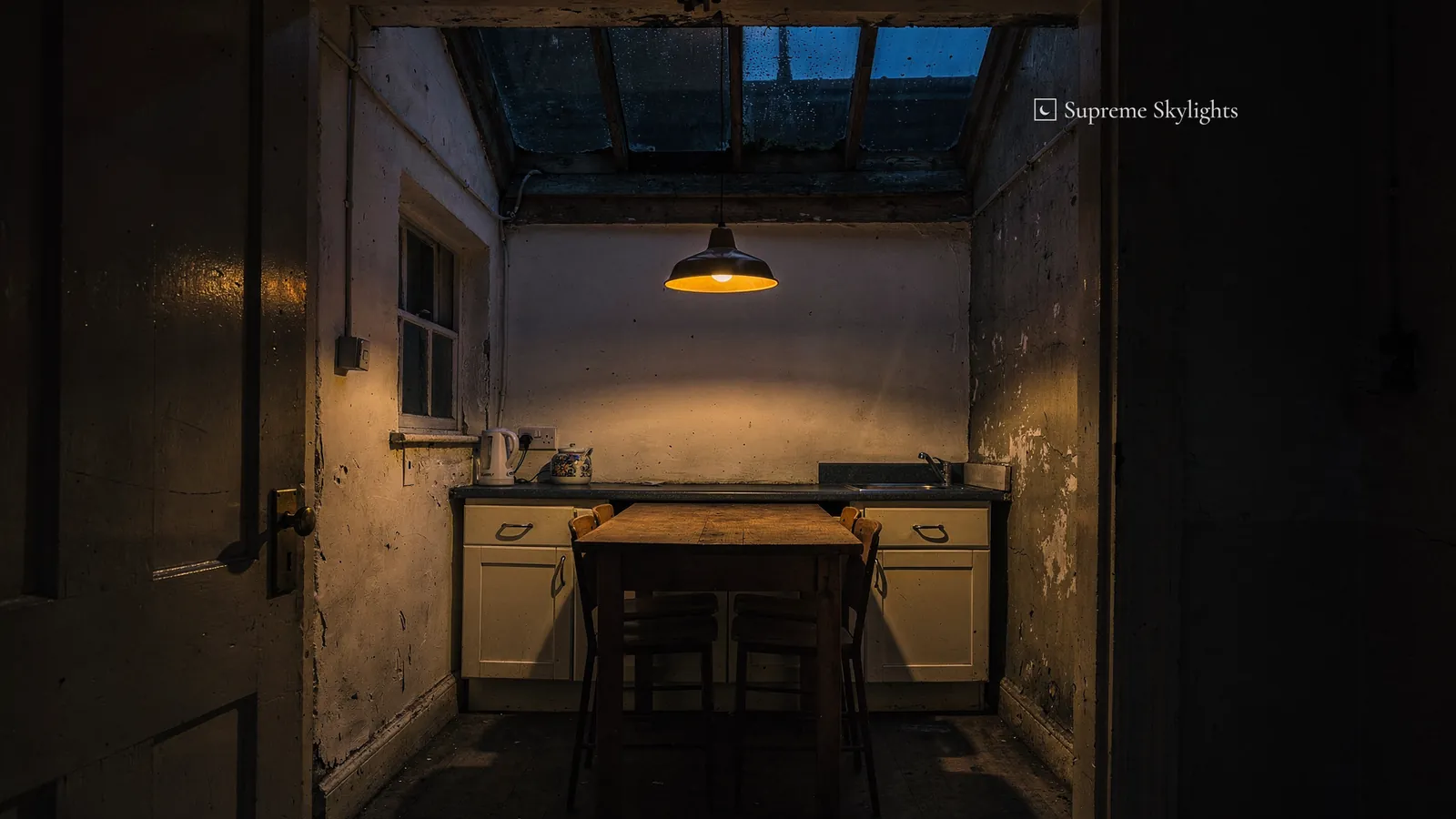 After dark
The Welsh rules for swapping glass or a rooflight
Building Regulations first, then planning, and what changes if only the glass is replaced.
Wales has its own Building Regulations guidance and its own planning rules, and they are not always the same as England's. Two separate questions arise, and a misted rooflight can raise either one, depending on what gets replaced.
Building Regulations come first. The regulations class every window, roof window and rooflight as a controlled fitting, which makes fitting one building work. Replacing a window or roof window with its equal still counts. Changing only the glass and leaving the frame where it is sits outside the energy rules. That is why choosing between fresh glass and a complete replacement also decides which paperwork follows.
For a whole replacement, Approved Document L (Wales) is the guide. It is guidance, and it says a roof window fitted new or as a replacement should reach 1.4 W/m²K or Window Energy Rating Band B, while a rooflight should reach 2.2 W/m²K. For a rooflight the figure is worked out over the full developed surface of the unit, an area often larger than the opening in the roof. Glazing safety sits in Approved Document N in Wales.
Loft bedrooms bring a further check. Approved Document B (Wales) says that when an old window big enough to escape through is replaced in a spot where a newly built house would need an escape window, the replacement should keep at least that escape potential. The survey notes whether a room falls into that group.
Welsh building control comes in two kinds, the local authority service and a private registered building control approver, and the choice between them is yours. Where the work is notifiable, the Building Regulations notification to either body is ours to handle. The Welsh Government's page on competent person schemes describes the route for replacement windows, roof windows and rooflights.
| What is replaced | Building Regulations | Planning |
|---|---|---|
| Sealed unit only, frame kept | outside the energy rules | check the unit stays within the original roof lines |
| Roof window like for like | still building work | council confirms in any doubt |
| Whole rooflight, new unit | guidance of 2.2 W/m²K for a rooflight | council confirms on article 1(5) land or in a World Heritage Site |
| Listed house | as above | listed building consent where character is affected |
Planning is the second question. A rooflight or roof window on a house can be permitted development when it stands no more than 15 cm (150 mm) proud of the plane of the original roof slope and rises no higher than the highest part of the original roof. A like-for-like swap may leave that position as it was, but a unit that stands further out might not, so the survey checks. If it is unclear, the council's planning team can give an answer, and a Lawful Development Certificate makes it formal.
Some land is treated differently. A house on article 1(5) land, which covers conservation areas, National Parks and Areas of Outstanding Natural Beauty among others, has no permitted development for a rooflight in its roof slope, and a World Heritage Site carries the same restriction as a category of its own. The boundary is what counts, and a house outside it is unaffected. Newport City Council publishes its conservation area maps. Flats and maisonettes sit outside householder permitted development altogether. Rights can also be withdrawn by a council through an Article 4 direction, or by a planning condition attached to the house's original permission. Listed building consent is required where the work would affect a listed house's character, and the local planning authority handles the application.
Our planning guide goes through each case, and the answer on the paperwork for a misted rooflight in Wales takes the Building Regulations side further.
After dark, with the new glass in
Black panes, loft blinds, and what a cold pane does by morning.
With the lamps on and the sky dark, a rooflight turns black and mirrors the room. That is true of clear glass and misted glass alike, so night is a poor time to judge a unit. Mist shows best by day, and it is worth looking at the glass in the morning before deciding that a rooflight has gone.
What the evening does show is how the room uses its opening. Over a bed, the question is darkness, and a June morning brings light early. Blackout blinds for loft bedrooms depend on the window, since the maker decides which blinds fit which windows, and that gets asked before the order goes in. Over a kitchen table, the black glass doubles the pendant lamps, one set hanging in the room and a second seeming to hang above it, and nothing about the glazing needs to change for that.
Moisture by morning
Overnight a rooflight pane often runs colder than anything else in the room, so it is where moisture from cooking, washing and breathing lands first. Beads on the room-side face on a winter morning are ordinary condensation and wipe off. A pane insulated to a higher standard can stay warmer on the room side, and moving damp air out of the room gives it less to settle on. Cloud between the panes is a different matter, because it stays after the room has dried.
Lighting an opening
Lighting the lining round a rooflight is a choice for the household and its electrician. Small fittings set into the lining can wash the plaster with light while the glass above stays black, and they have to be planned before the lining is closed, since the wiring sits behind it. A rooflight itself never gives out light, and only the lit room below shows in it.
Next steps
If a rooflight in your home has clouded, the next step is a free survey, followed by a fixed written quote. Replacement work carries a 10-year workmanship guarantee in writing. Use the quote form further down to ask for a visit, and the WhatsApp number and email address are on the contact page.
Guides and answers for misted rooflights
Misted rooflights: asked in Newport
Why has my rooflight gone cloudy between the panes?
The seal that closes the gap between the panes of the sealed unit has usually failed, so damp air has got in and condensed on the inner faces of the glass. Cleaning does nothing, because those faces are inside the unit. A survey shows whether new glass or a whole new rooflight suits, and what can be done about a misted rooflight explains more.
Can the glass alone be replaced, or does the whole rooflight go?
Sometimes the glass alone can be replaced, when the frame is sound and a matching sealed unit is available for that make and age of rooflight. Otherwise the whole rooflight is replaced. We check at the free survey, and new glass or a new rooflight compares the two routes.
How do I tell mist between the panes from damp on the room side?
Damp on the room side wipes off and comes and goes with the weather and with cooking or showers. Cloud between the panes stays whatever you do and cannot be wiped. Looking in the morning, when the sun lights the whole sheet of glass, makes the difference easy to see.
What happens at the survey for a misted skylight?
We identify the type and size of the unit, look over the frame and the flashing or upstand, and ask how the room gets used from morning to night. A free survey comes first and any price follows it, as a fixed written quote.
Is a replacement treated as building work in Wales?
Fitting a new window, roof window or rooflight is building work, and replacing a window or roof window with an equivalent one is too. Changing only the glass in a frame that stays is outside the energy rules. Where the work is notifiable, we handle the Building Regulations notification with local authority building control or a registered building control approver.
How far from Newport do you work?
Homes up to 30 road miles from the city, from Cardiff, Caerphilly, Cwmbran and Chepstow in Wales to Bristol and South Gloucestershire beyond the Severn, where English rules apply. Each place is listed on the areas page.
What guarantee comes with a replacement?
Every replacement is covered by a written 10-year workmanship guarantee, set out in full on our guarantee page.
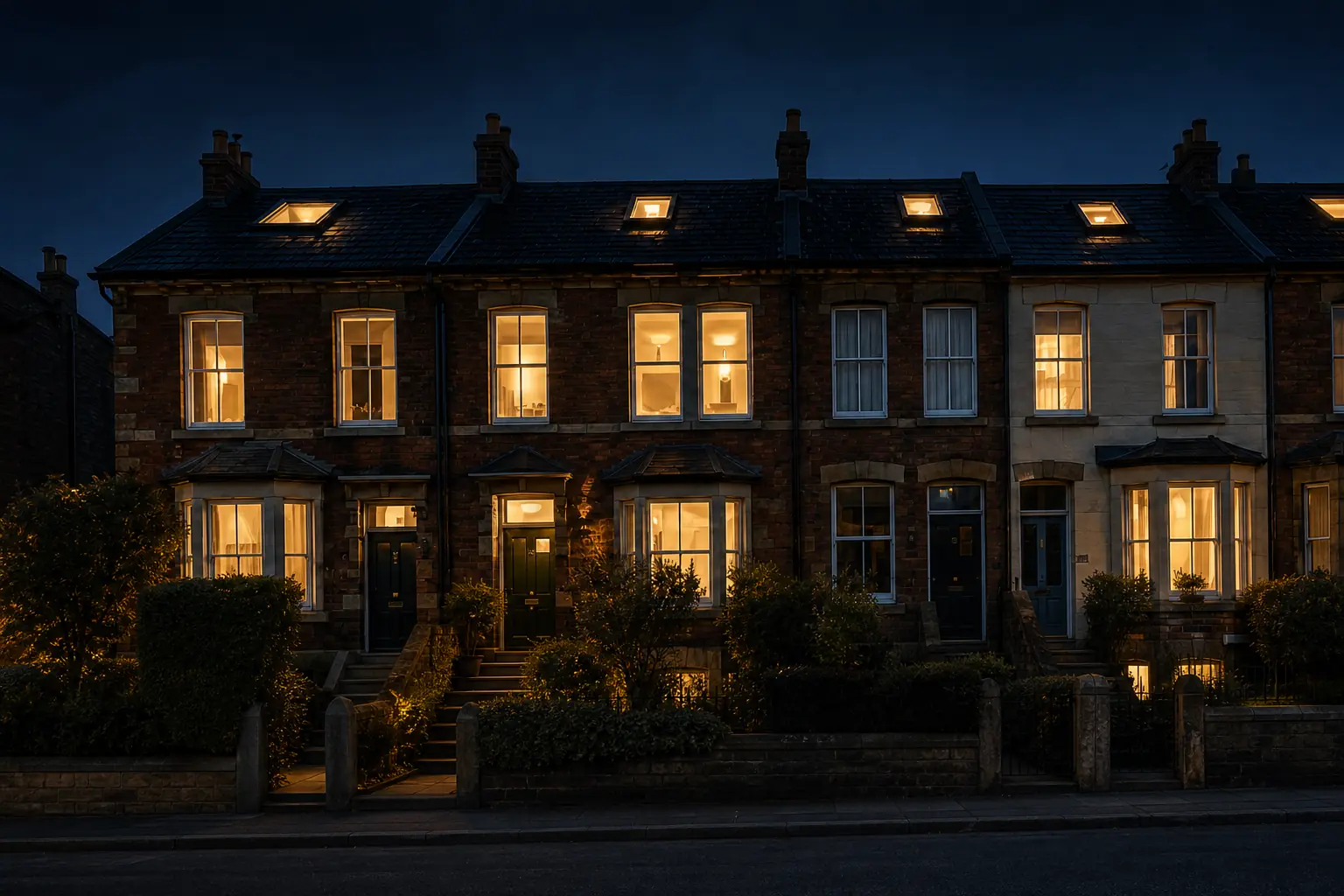
Good after dark.
The right light, in the right place, for the hours after ten.
Book your free survey
- 10-year workmanship guarantee
- We handle the Building Control notification where notifiable