Evening, night and first light

Good after dark: rooflights in the evening, at night and at first light

Product by product: what each rooflight is like when the lamps go on, through the cold small hours, and when the first daylight reaches the room.

Evening
the glass turns dark
Night
cold glass, condensation
First light
blackout for sleep
Lighting
wired before plastering
Book a free survey
Call 01633 327063
  • 10-year workmanship guarantee
  • We handle the Building Control notification where notifiable
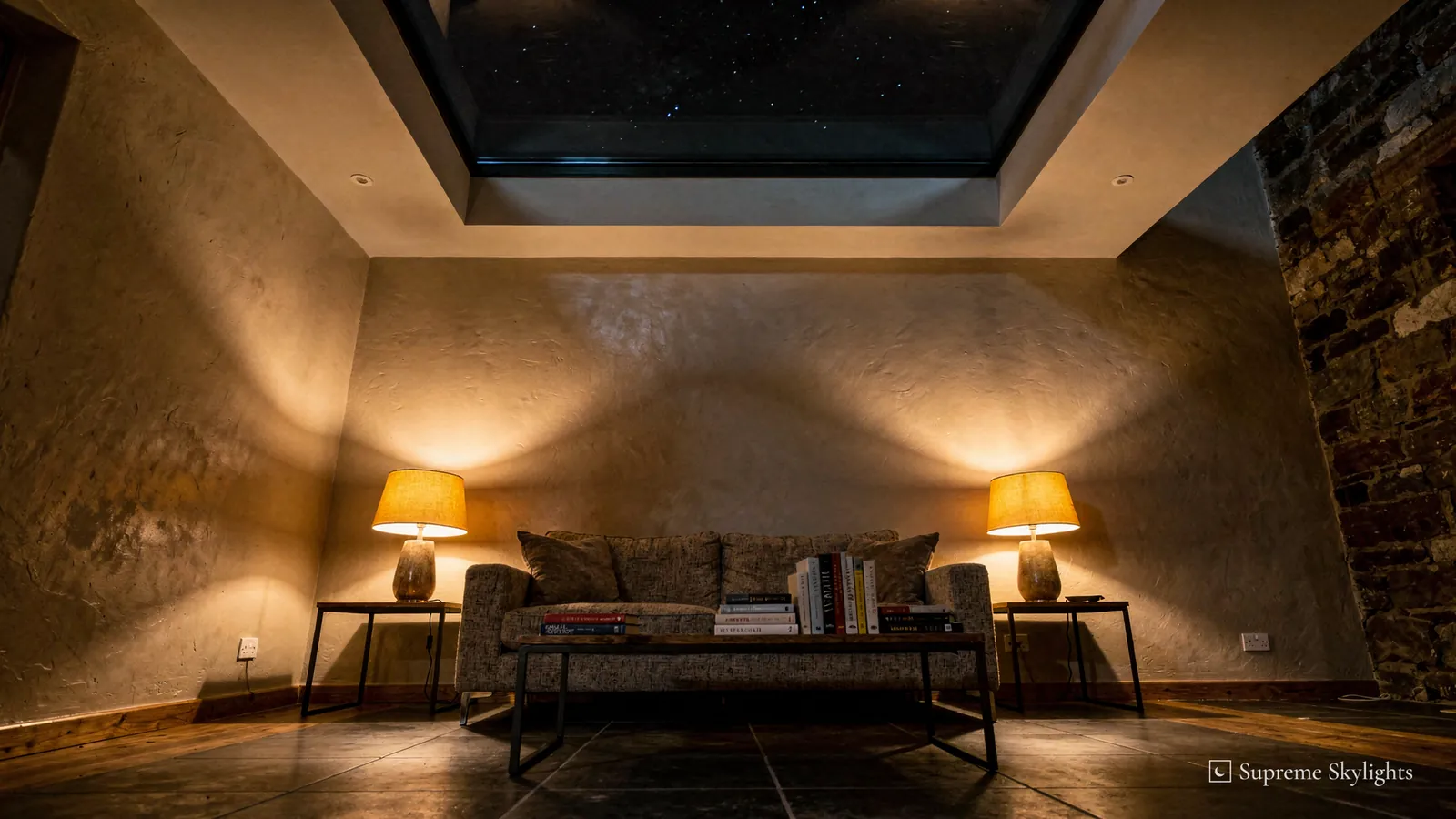
A sitting room at night under a large flat rooflight with a few stars in the black glass, two lamps lit

Daylight is what people think of when they think about glass in a roof, and for some hours of the day it is what a rooflight is for. A household under that glass keeps other hours too. On a winter weekday in Newport, anyone commuting along the M4 or by train to Cardiff or Bristol can leave home before the sky is light and get back after it has gone dark, so on those days the rooflight is something they see with the lamps on.

Four things decide how a rooflight lives with those hours. Once the sky behind it is dark, the glass reflects the room. On cold nights, moisture gathers on it. In a bedroom, it has to let the room go properly dark, including on early summer mornings. And when there is no daylight in the opening, the way it is finished and lit decides how it looks from the sofa or the bed.

Each product between dusk and dawn

Each kind of rooflight we fit changes in its own way once the daylight goes, depending on where it sits and which room it serves. A roof lantern over a kitchen and a roof window over a bed face the same dark sky and give very different evenings.

Rooflights from evening to first light
ProductEveningNightFirst light
Roof lanternPendants show back in the glassFrom the garden, the lit kitchen shows throughDaylight returns to the middle of a deep room
Flat roof rooflightTurns from sky to a dark panelRain on level glass can be heardLight from straight overhead
Roof windowReflects the nearest lampCold glass gathers condensationEarly light in June without blackout
Sun tunnelLess to carry as the sky fadesA plain disc with nothing behind itBrings daylight back to the landing
Walk-on rooflightA dark panel from belowFrom above, the lit room beneath showsDaylight into the room underneath

The night diary

One night under the glass, room by room

From the kitchen at teatime to the loft at first light: what each rooflight does while the house is lit, asleep and waking.

Lamps on under the lantern

The kitchen extension at teatime, as the sky above the glass loses its colour.

In midwinter the daylight leaves a kitchen extension early. A roof lantern that filled the table with light at lunchtime is a grey frame by the time the oven goes on, and once the pendants are switched on the glass changes character. Seen from inside a lit room, glass with darkness behind it acts as a weak mirror. Look up from the hob and the lantern shows the kitchen back to you: the lamps, the tops of the cupboards and the people at the table, in front of the dark sky.

That reflection comes with any glass overhead, so the useful question is what it will show. Where the lantern sits over the room decides that. Centred over a dining table, it tends to repeat the pendant lamps and the table beneath them, which reads as part of the room. Set over a run of worktops, it picks up the wall units and the extractor hood instead. The upstand plays a part as well. For its lanterns, Brett Martin gives 150 mm as the minimum height for the builder's upstand, and the depth and finish of the lining between the ceiling and the glass decide whether the opening looks like a dark recess with crisp edges or an unfinished gap in the ceiling.

Lighting the upstand

A lantern has no light of its own, so its evening look depends on the light placed near it. One approach is a strip of light set into the upstand or the lining at the base of the lantern, which lights the sides of the opening after dark and leaves the glass above it dark. Downlights in the ceiling around the opening are another route. Either way, the cable runs behind the plasterboard, so the decision belongs early, before the lining is boarded and plastered. Adding light to a finished upstand usually means opening it up again.

The lantern through one evening

  1. 15:30FadingThe sky greys and the glass loses its colour.
  2. 16:30Lamps onThe pendants appear in the glass above the table.
  3. 21:00From the gardenThe lit kitchen shows through; the glass gives off no light.

This is electrical work, separate from the rooflight itself, and it is easiest to settle with whoever is wiring the extension at the same time as the rest of its lighting. A plan drawn up before the ceiling goes in can show the pendants, the downlights and any upstand light together, so the lantern and the lamps beneath it are thought about as one.

From the garden

Step outside after dark and the lantern behaves differently. From the garden the glass no longer mirrors anything: the lit kitchen shows through it, seen from above and to the side. The glass itself gives out no light. How much of the room is visible depends on which lamps are on and where you stand, which is worth keeping in mind when neighbours' upstairs windows look down onto the extension roof. More on the product and the choices behind it is on our roof lanterns page.

The back addition and the terrace

Flat glass over a kitchen or bathroom, and glass you can stand on, once supper is over.

A flat roof rooflight is the plainest case after dark. A flat roof rooflight stands on an upstand above the deck, and from below it reads as a single rectangle in the ceiling of a back addition, a kitchen or a bathroom. With the room lit and the sky black, that rectangle reflects whatever is directly beneath it, which over a kitchen island or a bath is a small patch of the room. Where the upstand and the lining below it are deeper, the glass sits further back from the ceiling and can catch less of the room from across the space.

Rain is the other thing flat glass brings to an evening. Water on a level or nearly level pane lingers longer than on a slope, and in a quiet room after supper you may hear it. For its flat glass rooflights, Rainclear's advice is a kerb with a slope of 5° or more to minimise water pooling, with any upstand built to the maker's details. For the glazing itself, VELUX makes its flat and curved glass rooflights in double- and triple-glazed versions, and puts that down to energy efficiency and sound reduction.

Glass underfoot after dark

A walk-on rooflight turns the after-dark view around. From the room below in the evening, it behaves like any flat glass overhead: a dark panel holding a faint reflection of the lamps. From the terrace or roof above, with that room lit, the panel shows the room beneath to anyone standing over it. What they see is the lit room through the glass, and nothing else.

Flat glass after supper

Seen from below
a dark panel, faint reflections
Seen from above
the lit room beneath
Rain
heard in a quiet room
Kerb slope
to the maker's details
Glazing
double or triple, by product

That matters where the walk-on panel sits in a terrace people use on summer evenings, or where it brings daylight into a bedroom or bathroom underneath. The room below sets how much is on view: which lamps are on, where they stand, and what sits directly under the glass. A desk lamp beside the panel shows far less than a pendant hung right beneath it. Thinking through how the room is used in the evening, before the position of the panel is fixed, makes that easier to settle.

Daylight is what a walk-on panel is chosen for, and in the morning it brings light straight down into a room that may have little else. The evening view from above is the trade for that, and a lamp placed to one side of the glass keeps the terrace view of the room modest. For a flat roof that people never walk on, the same thinking about position applies to an ordinary flat rooflight seen from an upstairs window next door.

Two related pages go further: whether a skylight can be walked on, and fixed or opening flat rooflights for a back addition that needs air as well as light.

The landing and the stairwell

A sun tunnel with nothing to carry, and an opening rooflight high above the stairs.

Nothing comes down a sun tunnel once the sky is dark. A sun tunnel (some people say light tube) collects daylight at the roof and carries it down a reflective tube to a diffuser in the ceiling, and with no daylight there is nothing for it to carry. In the evening the diffuser sits in the landing or hall ceiling as a plain round disc, lit only by whatever lamps are on nearby.

That makes the landing's own lighting part of the decision. Sun tunnels are chosen for landings, hallways and windowless bathrooms where a full roof window is impractical, and those are exactly the places people walk through at night. A ceiling light near the diffuser, or a low light on the stairs, covers the hours after dusk. Planning where the light fitting and the diffuser go at the same time keeps them from crowding the same patch of ceiling.

The diffuser takes on the colour of the light around it after dark. Under a warm landing light it reads as a pale disc; with the landing dark it is barely there. Either way it is the room's lighting doing the work, and the tube itself has nothing to add until morning. The length of the tube makes no difference here. Whether it drops a short way through a bungalow loft or runs further down through a two-storey house, the diffuser looks the same once the sky outside is dark, and the hall light beside it is what anyone coming up the stairs actually sees.

The landing through one evening
HourSun tunnelElectric rooflight
Late afternoonLess light as the sky fadesOpen for air if wanted
EveningA plain disc, lit by nearby lampsClosed from the foot of the stairs
NightNothing to carryA dark shape above the stairs

An opening rooflight over the stairs

Stairwells and tall landings are where an opening rooflight is hardest to reach by hand, and that is where electric opening rooflights suit. In the evening the question about them is a practical one: is it shut? Depending on the product, a wall switch or a remote lets the rooflight be closed on the way up to bed, with no pole or stepladder involved.

After dark, glass high over a stairwell reflects the landing light back down, and from the hall below it shows as a dark shape at the top of the stairs. The finish of the shaft between the ceiling and the glass, and whether any light is set into it, decide whether that shape looks complete. Light in the shaft is best wired before plastering, in the same way as light in a lantern's upstand, because the cable has to run behind the finished surface.

A tall stairwell shaft can be lined in a pale finish so that a single light at its base carries up its sides, or left to the landing light alone. Both are choices to make while the shaft is still open, and our page on how an electric rooflight is powered covers the wiring side of the rooflight itself.

Steam under a bathroom roof window

Bath time under the slope, when warm, wet air meets cold glass.

Run a bath under a roof window on a winter evening and the glass will usually show it within minutes. Warm air holds a good deal of moisture. When that air reaches a surface colder than itself, it gives some of the water up as condensation, and in a bathroom under the roof the glass is frequently the coldest thing it meets. The droplets that form on the room side of the pane come from the room's own steam.

Ventilation is what clears it, and a roof window that opens lets the steam out after a bath. Approved Document F (Wales) asks that replacing a window leaves the home's ventilation no worse than it was. If the window coming out had trickle vents, the one going in should have vents at least as large, controllable by the occupant or automatically, unless the home has continuous mechanical supply and extract ventilation. If it had no trickle vents and the house is naturally ventilated, a bathroom vent of 4,000 mm² equivalent area or more is one way to show ventilation has not got worse; where that size is not technically feasible, the vent should come as close to it as is feasible.

What the street sees

The other evening question in a bathroom is privacy. From inside, the dark glass mirrors the room and looks solid. From outside, with the bathroom light on, the room shows through to anyone placed to see the glass. How much they can see depends on the pitch, where the window sits on the slope, and what overlooks it. A roof window high on a rear slope is generally in view of fewer windows than one low on a side slope facing a neighbour.

Wales has a planning condition for exactly that side slope. A rooflight on a side-facing roof slope that, projected down to the ground, would be within 10.5 m of the boundary opposite that side must be obscure-glazed, and must be fixed shut unless the opening part is at least 1.7 m above the floor or stair directly below it, and it must stay that way, for the work to be permitted development. The Welsh section of our skylight planning permission guide gives the rest of the rules.

A blind is the other answer in a bathroom at night, and the same thinking as in a bedroom applies: whether one is made for the window, and how it is worked, comes down to the maker and the model. On a window set high in the slope, a blind that can be worked from the floor saves climbing on the edge of a wet bath. A short airing after bath time, with the window open and the bathroom door shut, sends the steam outside instead of across the landing, and the pane tends to clear sooner.

Bedtime in the loft

A roof window over the bed, a reading lamp, and a room that has to stay dark until morning.

Whoever sleeps under a VELUX window or any other roof window sees the bedside lamp in the glass first. With the lamp on, the pane above shows the lamp, the headboard and the sloping ceiling around it. Switch it off on a clear night and the reflection fades, and the sky shows through instead. On a cloudy night the pane simply stays dark.

Before sleep, the question turns to darkness. Summer mornings in Wales get light very early, and a roof window faces the sky directly, so a loft bedroom without blackout can be bright long before anyone wants to be awake. Blackout belongs in the choice of any roof window for a bedroom, nursery or loft room, from the start. Whether a blackout blind is made for a particular window, and how it is worked, depends on the maker and the model, so the blind is best chosen together with the window, from what that maker offers.

Reaching the window at bedtime

A window within reach of the floor can be opened and closed by hand at bedtime. A window high up the slope, above the stairwell or over a bed beneath a low ceiling is another matter, and electric or solar operation suits it, along with a blind that can be worked from below. Being able to shut the window and draw the blackout from the bed is a small thing at noon and a large one at half past ten in January.

A sleeping room under the roof

Blackout
chosen with the window
Reach
by hand, or electric or solar
Blind
worked from the floor if the window is high
Bedside lamp
shows in the glass
Clear night
the sky, once the lamp is off

The reveal, the lined sides between the ceiling and the frame, decides how the window looks with the lamp on. A neat, pale reveal frames the dark glass. A rough or patchy one draws the eye upward in the evening, when the lamps are on and the bed is right below it.

Where the bed goes matters as much as where the window goes. A bed under the glass gives the view of the sky on a clear night and the first daylight on a summer morning in the same place. A bed against the opposite wall keeps the window in view without putting the brightest part of the early morning over the pillow. Settling that with the room's layout before the opening is cut is simpler than moving furniture around a window afterwards, and our centre-pivot or top-hung roof window comparison sets those two ways of opening side by side.

In a nursery the hours that matter start earlier. A baby put down at seven on a June evening needs the room dark while the sky outside is still bright, so the blind does its job at both ends of the night. A street lamp across the road can also show in a roof window from inside after dark, and the same blackout deals with that.

The cold hours

Condensation, misted units, and what the energy guidance asks of glass in the roof.

Why does a rooflight run with water on some mornings and stay dry on others? The answer starts in the small hours. Overnight the air outside drops towards its coldest, the heating may have been off for hours, and the people asleep in the house keep adding moisture to the air with every breath. Glass in the roof faces the open sky, so on a clear, cold night its inner face can end up the coldest surface in the room. Moisture settles there first and, by morning, may have run down onto the frame or the sill.

Which rooms show it follows from where moisture is made: bedrooms slept in with the door shut, and bathrooms after a late shower. Ventilation is what helps. A window left open a crack, or trickle vents left open overnight, give the damp air somewhere to go before it reaches the glass. In a kitchen, an extractor run for a while after a late meal does the same job for the cooking steam.

Misting between the panes

Water on the inside face of the pane is condensation from the room, and a cloth will take it off. Water trapped between the panes is a different thing. The space inside a sealed unit is meant to stay dry, and when the seal around its edge gives way, damp air can find its way in and condense between the two panes, beyond any cloth. That is a failed unit, and our page on misted rooflights covers the choice between a new sealed unit and a whole new rooflight. Under the Welsh energy rules, swapping the glass alone and keeping the frame in place falls outside building work.

What the energy guidance asks

Approved Document L (Wales) gives figures for glass in the roof. A new or replacement roof window in an existing home should be no worse than 1.4 W/m²K, or meet Window Energy Rating Band B, and a new or replacement rooflight should be no worse than 2.2 W/m²K. Those are guidance figures about energy, and the glazing choices that meet them are covered under energy-efficient rooflights.

The same guidance says installed roof windows and rooflights should be fitted well and be reasonably draught-proof, which is the part a household notices on a cold night. A draught felt near the glass at three in the morning can come from cold air sliding down off a chilled pane as well as from a gap.

The cold hours are also when a failing sealed unit gives itself away. A pane that looks clear on a mild afternoon can show a grey bloom between its layers at dawn, and that is worth a photograph before it fades, because it is the sign that separates a unit to replace from glass that only needs airing.

The first daylight

Early summer mornings in the loft, on the landing and under an old slate roof.

Early on a June morning, the sky above a loft bedroom can already be light while everyone else in the house sleeps. A roof window faces that sky head on, and without blackout the room brightens as the sky does. With a blackout blind drawn, the same room can stay dark until the alarm, and the daylight comes in when the blind is opened.

Winter turns the hour round. On a December weekday the alarm can go off in full darkness, and someone getting ready for the M4 or an early train to Cardiff or Bristol sees the roof window only as black glass with the bedroom lamp in it. For those months, the reflection and the finish of the opening are what a household lives with on working mornings. In midwinter, the first proper daylight in a loft room can arrive after everyone has already left for the day.

The landing in the morning

The sun tunnel that sat idle all evening starts working again as soon as there is daylight to collect. On a landing or in a hallway with no window, the diffuser can be the first daylight anyone meets on the way to the bathroom, with no switch to find. Its brightness follows the sky, so on a grey morning it is soft and on a clear one it is strong.

Whether a rigid or flexible sun tunnel suits a house is a daytime decision, and after dusk the landing's own light takes over again.

First light, room by room
RoomWhat the first daylight does
Loft bedroomComes straight through the glass unless blackout is drawn
Landing with a sun tunnelReturns at the diffuser, no switch needed
Kitchen under a lanternLightens the middle of the room before the lamps go on
Attic under a conservation rooflightA small, high patch of sky; blackout if someone sleeps there

Downstairs, the lantern that mirrored the pendants the night before shows the sky again as soon as it brightens. With no lamps on, nothing competes with it, and the middle of a deep kitchen extension, the part the back windows struggle to reach, takes its light from above while the kettle boils.

Under an old slate roof

Older houses bring a different first-light question. A conservation rooflight can have a slim frame and sit low in the slope, and in the attic of a Victorian terrace it can be the only glass in a small room. If someone sleeps there, it needs blackout for the same reasons as any loft bedroom.

The planning side is different. In Wales, adding a rooflight to a roof slope of a house on article 1(5) land, which includes a conservation area, a National Park and an Area of Outstanding Natural Beauty among others, or within a World Heritage Site, is not permitted development and needs a planning application. On a listed house, a rooflight that would affect its character as a building of special architectural or historic interest needs listed building consent, applied for through the local planning authority. The Welsh planning rules are set out in full in our guide, and what a conservation rooflight is covers the product in more depth.

Rooflights at night: your questions

Why does a rooflight look black at night?

With the room lit and the sky dark, the light from the room reflected in the glass outweighs the little that comes through from outside, so the pane reads as dark glass carrying the lamps and the ceiling. Where the opening sits and how its lining is finished decide whether that looks deliberate. On a clear night, with the room lights off, the sky shows through again.

Can a rooflight light the room in the evening?

A rooflight makes no light itself. What can be lit is the opening around it: a strip of light in a lantern's upstand, or lights set into the lining of a roof window's reveal or a light well. That cabling runs behind the plaster, so it is best decided before the ceiling is finished, with the electrician wiring the room.

How dark can a bedroom in the loft get with a roof window?

That comes down to the blind. Blackout is best chosen with the window, from what its maker offers for that model, and on a window out of reach, electric or solar operation can let the blind be worked from the floor. In June, when mornings get light very early, that choice decides how the room sleeps.

Do people outside see into a room under a rooflight at night?

They can, if they are somewhere with a view of the glass. Inside, the dark pane mirrors the room; outside, the lit room shows through. Pitch, the window's place on the slope and what overlooks it all make a difference. Wales also has a planning condition for side-facing slopes within 10.5 m of the boundary opposite, which our planning guide sets out.

What does a sun tunnel do after dark?

Nothing, until daylight returns. It carries only daylight, so in the evening the ceiling diffuser is just a plain round disc and the landing or hall needs its own light nearby. It starts working again with the first daylight of the morning.

Why is the rooflight wet on cold mornings?

Moisture from the room settles on the coldest surface it meets overnight, and glass facing a clear sky can be that surface. Airing the room, and leaving any trickle vents open, gives the damp air somewhere else to go. Water trapped between the panes is another matter: it points to a failed sealed unit.

Book your free survey

We come to the house in Newport, look at the roof and the room together, and send a fixed written quote.

  1. 08:30Survey: we look at the roof and the room
  2. 16:00Quote: a fixed written quote
  3. 07:30Fit: then the Building Control notification, where notifiable
  • 10-year workmanship guarantee
  • We handle the Building Control notification where notifiable

Request my survey

10-year workmanship guarantee.
Building Control notification handled where notifiable.