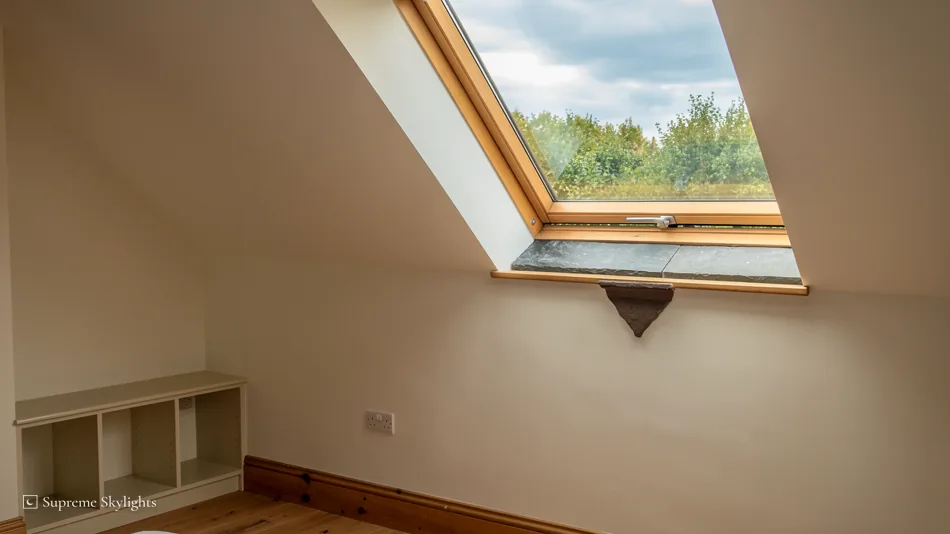
A question about VELUX windows and the Building Regulations can start from a job already in mind. A leaking window on a landing needs replacing. A loft is about to become a bedroom. A bathroom under the slope wants a window it never had. The rules in Wales treat these differently, so this guide takes them as jobs: a like-for-like swap, a new opening, a loft room and an older or listed house. The short answer for any roof window has its own page.
Each section begins with the job and then says which parts of the Welsh guidance bear on it: the energy figures, ventilation, escape, glazing safety and who checks the work. Planning is a separate question with its own guide, linked where it comes up, and the general Approved Document rules for every rooflight type are laid out elsewhere. Houses across the Severn follow English rules, which are covered elsewhere on the site.
The first question: is it building work at all?
Under the Building Regulations 2010, as amended for Wales, windows, roof windows and rooflights all rank as controlled fittings. That is the label the regulations give to fittings on which a requirement bites, and it is why fitting one counts as building work. A VELUX roof window is no exception.
Two details shape most jobs. A swap for a matching window sits inside the rules, and a plain repair sits outside them. And when only the glass is replaced and the frame stays, that does not count as building work for energy purposes. We look at that case separately in replacing just the glass of a VELUX.
So the question to ask of any job is what exactly is changing. A new frame, a new position, a new size or a brand-new hole each push the work towards notification. A cleaned, adjusted or repaired window does not.
Ask what is changing: the frame, the position, the size or the hole. Each one moves the job towards notification.
Job one: swapping a tired window on a landing
A landing window that has been fitted for years and now leaks, mists or sticks is a typical case. Here the existing opening is reused and the new window goes in the same place, which keeps the job within the replacement rules.
The Welsh Government publishes information on competent person schemes, under which an installer registered with an authorised scheme can notify the local authority of a replacement window or roof window and issue a certificate of compliance. See its page on competent person schemes for the detail. Those schemes are for replacements. On any job where the work is notifiable, we handle the Building Regulations notification with local authority building control or a registered building control approver.
Tell us what is wrong with the old window: a leak after heavy rain, a pane that has misted, a sash that sticks or a handle that no longer turns. It helps us judge whether the frame or only the glass is at fault. The new window has an energy target. Approved Document L (Wales) says a roof window put in as a new or replacement fitting in an existing home should achieve Window Energy Rating Band B, or a U-value no worse than 1.4 W/m²K. Because the document is guidance, it is worded as a standard the window should meet rather than as a command. Its 2022 edition, with the 2024 corrections, is the current one. A later edition arrives on 4 March 2027 and leaves the window figures as they are.
Ventilation comes along with the swap. Approved Document F (Wales) wants a replaced window to leave the home's ventilation as good as it was. If the old frame carried trickle vents, the new frame should carry vents of at least that size, adjustable by the occupant or by an automatic control, unless the house has continuous mechanical supply and extract ventilation.
Job two: a window where there was none
A bathroom under the slope with no natural light is the typical case. Cutting a new opening in the roof is a bigger step than a swap. The Welsh Government's view is that a new rooflight will generally call for approval, and the same reasons can arise with a new roof window. The structure of the roof will usually need altering to form the opening, and it either carries the added load of the unit as it is or is strengthened to do so. The unit must also be energy efficient, and a boundary close by brings its fire performance into question.
The competent person schemes mentioned above are aimed at replacements, so a new opening will generally need approval from a building control body. There are two kinds in Wales, and the choice between them is yours. One is the local authority building control service. The other is a private registered building control approver. Private firms must be registered with the Building Safety Regulator, and registered building inspectors either do the checking or advise on it. That regime started on 6 April 2024. The older approved inspector route has closed, since unregistered inspectors could only carry on ordinary work until 1 October 2024.
The regulator for local authority building control is the Welsh Ministers. The Building Safety Regulator oversees the private side. The Welsh Government's page on regulation of the building control profession explains the split.
Planning comes first for a new hole. If the house stands within a World Heritage Site, a National Park or a conservation area, among other protected boundaries, the first conversation is with the planning authority. Read the Wales part of our planning guide, then does a VELUX need planning permission for the window itself.
Job three: a loft that becomes a bedroom
A VELUX window in a loft bedroom does two jobs, because it lights the room and may also be the way out. Approved Document B (Wales) sets the measurements for an emergency escape window. The unobstructed opening must give at least 0.33 m², with a width and a height of 450 mm or more, and the lower edge of the opening may be no more than 1,100 mm off the floor. It must lead the person to somewhere free from danger from fire. In a roof window, a note allows the bottom of the opening to be 600 mm above the floor, in place of the usual 800 mm guarding height.
A window like this should also remain open unaided, and a stay or lock is fine provided the stay carries a release catch. Those escape provisions assume floors no more than 4.5 m above the ground. Above that, the house needs a protected stairway, or the top storey must be separated with its own alternative escape route, unless it has more than one separated internal stair.
A loft conversion in a two-storey house normally brings a bigger change than the window. Fire-resisting doors and partitions down the full height of the stairway are the expected consequence where none existed before. Building control decides what your house needs, and we raise it at the survey so that it is no surprise.
On ventilation, each habitable room calls for purge ventilation, a means of airing it rapidly. A window that opens through 30 degrees or more serves for that when its opening area is one twentieth of the floor area. Between 15 and 30 degrees the area needed is one tenth, and below 15 degrees the window is not counted. The opening angle of the window we propose is therefore part of the specification.
Job four: an older or listed house
A window in an older roof can run into a second set of tests. For a replacement roof window on a home of architectural or historic interest, or where the character of a facade must be kept, and it cannot reach 1.4 W/m²K, the energy document gives a fallback of 1.2 W/m²K at the centre of the pane, or low-e secondary glazing. That relief covers replacement windows and roof windows alone. A rooflight does not get it, and nor does a brand-new opening.
If the house is listed, another consent applies besides the regulations. Under the Historic Environment (Wales) Act 2023, an alteration that would affect a listed building's character as a building of special architectural or historic interest needs listed building consent. Applications for that consent are made to the local planning authority, and inside Bannau Brycheiniog National Park that is the National Park Authority. Our page on listed building consent for rooflights in Wales goes through it, and Cadw's consent page is the official source.
Both questions are worth raising before the quote. Listed or unlisted, you will not be asked to commit to a price until the survey has been done.
Glazing safety, and what the document calls your window
Glazing safety in Wales is dealt with by Approved Document N. It looks at glass in critical locations, which means the lower 800 mm of walls and partitions and the lower 1,500 mm of a door or a side panel close to the door. Glass there should break safely, be strong enough or divided into small panes, or be protected for good. Where a window sits low in a sloping wall, the position is something we check at the survey. Requirement N3, about windows and skylights being safe to open and close, does not apply to dwellings.
Laminated and other safety glazing choices vary by window, so the glazing specification is something we settle with you at the survey.
Names matter in the energy document. A roof window is one set in plane with the slope, and a rooflight is a glazed unit out of plane with the roof, standing on a kerb or upstand. The first has a target of 1.4 and the second 2.2. VELUX makes both a window for a pitched roof and domes and glass rooflights for flat roofs, so the table line that applies follows from how the unit is installed. For a rooflight, the U-value is worked out from the developed surface of the whole unit, and where the kerb arrives already joined to the unit as a single assembly, the limit takes in the kerb too.
From survey to sign-off
We do the survey at no charge, ahead of any price. When we visit, we establish which of the four jobs above yours is, because that decides the route. Afterwards comes a fixed written quote, and a written guarantee of 10 years covers our workmanship.
If a VELUX window is already in the roof, read the code on it first. VELUX size codes explained shows where to find it. To set a budget, the cost of fitting a VELUX window lists what moves the figure.
The Welsh Government's Approved Documents page is the place to read the guidance for yourself. The broader page, skylight Building Regulations in Wales, covers every rooflight type.