
Nailsea is a North Somerset town, 29 road miles from Newport over the Severn, in a south-easterly direction
Skylight and rooflight fitting in Nailsea
- 10-year workmanship guarantee
- We handle the Building Control notification where notifiable
Coal mining since 1507, houses since then
Little is known of the area Nailsea occupies before the coal mining industry began, although it was used as a quarry in Roman times, when pennant sandstone was extracted. Nailsea's early economy relied on coal mining, which began as early as the 16th century, and the earliest recorded date for it is 1507, when coal was being transported to light fires at Yatton. The Elms Colliery, the Middle Engine Pit, is one of the most complete examples of an 18th-century colliery left in England, and it is now in disrepair. Nailsea is close to the M5 motorway and Bristol Airport, and its railway station, Nailsea & Backwell, has services operated by the Great Western Railway.
Beyond the colliery, houses from different periods give different reasons to look up at a roof, and those reasons change with each one. Older homes can carry roofs that have been re-covered more than once. Homes built after the war can have roof windows or rooflights that have lived through decades of weather. Newer extensions bring flat roofs. The survey looks at whichever of those is above you. Replacement is the question the table keeps returning to, because glass that has been up for years is where the questions begin: the misted pane, the energy figures, and the flat roof.
| Type of home | What sits in the roof | The question worth asking |
|---|---|---|
| Older house with a re-covered roof | A roof window that may be original | Whether the glass or the whole window needs replacing |
| Mid-century or later house with a loft room | A roof window of some age | Whether a misted pane is a sign of a failed seal |
| Home with a flat-roofed extension | A rooflight, perhaps a dated one | Which new unit meets the energy figure for a rooflight |
Replacement glass for tired roof windows and rooflights
11:00
North Somerset Council and what England allows
North Somerset Council is the planning authority in Nailsea, and England's rules apply to a house here. Adding a rooflight is usually permitted development under Class C, with limits and conditions that the England section of the planning guide spells out.
Nailsea Kingshill is among the conservation areas near the town. Being inside one leaves that right as it is. Two things can take it away: an Article 4 direction made by the council, and a condition written into the house's original or a later planning permission. Neither is visible from the street, so we confirm the address with the council first. The council's conservation area page links its map of the Article 4 areas.
A listed house still has Class C rights, but a new or altered rooflight on a listed building will almost always need listed building consent, and that consent decides the job. Flats have no householder permitted development rights.
12:00
Towns close to Nailsea
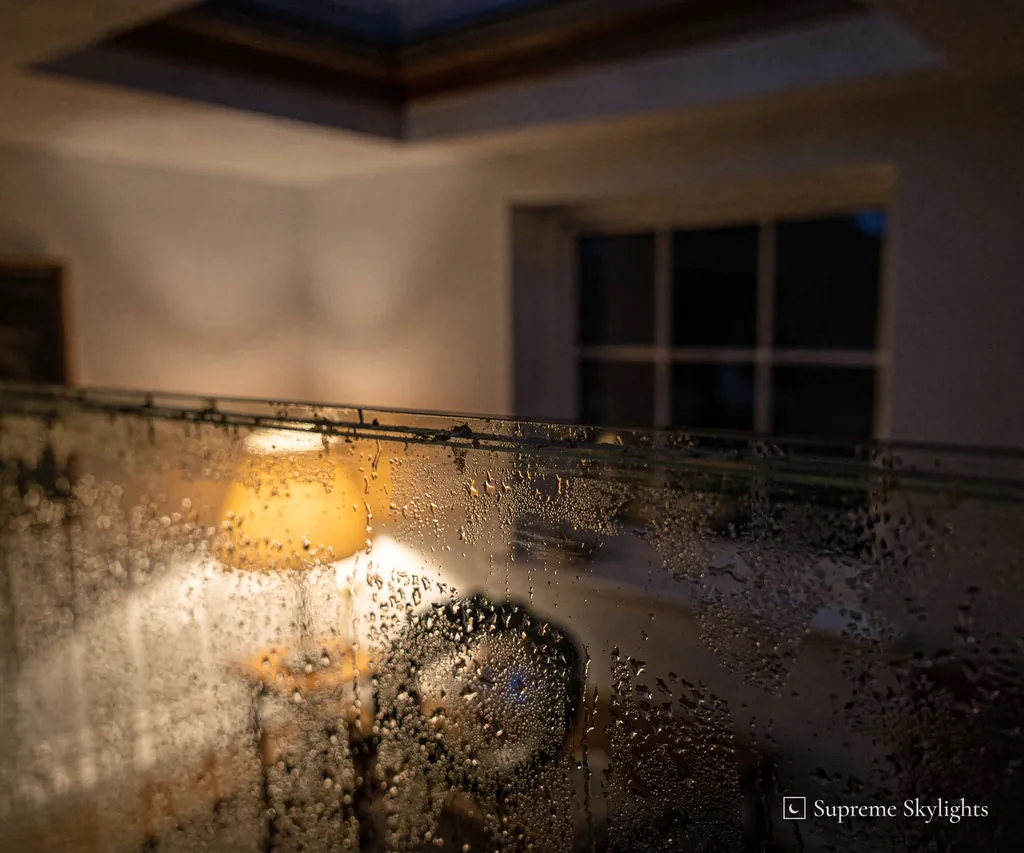
Droplets between the panes
A misted roof window, and what a sealed unit can and cannot do.
Is that a bad morning or a bad window? Condensation on the inside of a roof window clears with a cloth and some airing. Mist trapped between the two panes does not, because the moisture is sealed in with the glass. The first is a matter of the room's damp and the cold glass. The second means the sealed unit has stopped doing its job.
A roof window is frequently the chilliest thing in a loft bedroom at night, and breath can settle on it. That is ordinary night-time condensation, and it comes and goes with the weather and with how the room is aired. A misted unit looks different, because the cloud sits inside the sealed glass and stays whatever the room is doing.
Once a unit is misted, the choice is between replacing the sealed glass alone and replacing the complete window. Both jobs are ours, the sealed glass or the entire window, and the frame decides between them. A frame in good order can take a new sealed unit, while a frame that has failed, or that is no longer made, can point towards the whole window. Sealed unit or whole rooflight explains how that decision is reached.
New glass in a window that stays in its frame is not counted as a controlled fitting under the Building Regulations, and so the energy limits stay out of that job. Replacing the whole unit is different, and the Approved Document L figures then apply.
It is also worth knowing what misting is not. A misted unit is not a leak, and a leak is not a misted unit, although one can be mistaken for the other when a ceiling stain appears below a cloudy pane. Water coming through the lining points to the flashing or the seal at the edge, and cloud inside the glass points to the sealed unit. They are separate faults.
What to look at on the survey is simple. We check the frame and the seals, the flashing around it where the roof meets the window, and the lining inside, because a window that has misted might also be leaking at the edges. The glass and the frame are looked at together.
| Sign | Points towards |
|---|---|
| Frame sound, seals intact, glass clouded | New sealed glass in the existing frame |
| Frame worn or no longer made | A whole replacement window |
| Damp at the lining or flashing | A closer look at the surround first |
Two figures on a replacement
What the energy numbers are, and which one belongs to which product.
Ask for the figure, and ask which table it came from. When a roof window or rooflight is replaced in an existing home, Approved Document L sets the energy standard, and the figure depends on what is being fitted.
For a roof window, a new or replacement unit should have a U-value no worse than 1.4 W/m²K, or a Window Energy Rating of Band B or better. For a rooflight, which sits on a kerb or upstand and stands out of the plane of the roof, the U-value should be no worse than 2.2 W/m²K. The two numbers belong to two products, and they never swap.
The difference is in how the document defines each. A roof window is installed in the same orientation as the surrounding roof and in plane with it. A rooflight is a glazed unit installed out of plane with the surface of the roof, on a kerb or upstand. When you read a quote, check that the figure given matches the type of unit named.
A replacement element should also be no worse than the one it replaces. Where a roof window would be expected to meet the figure but the building's character prevents it, the guidance offers a centre-pane U-value fallback, and that is a conversation to have about a period house, not a general allowance.
Both numbers refer to the finished unit and not to the glass alone. The terms are worth having at hand when two quotes arrive that do not look the same. If one names a roof window and gives 2.2, or names a rooflight and gives 1.4, something has been mixed up, and it is a good moment to ask which unit is meant.
Draught-proofing sits beside the figure. New and replacement windows, roof windows and rooflights should be draught-proofed and meet the table limits. How the figure is worked out matters for a rooflight: it is based on the whole outer developed surface area, which can be larger than the hole in the roof.
The energy page covers it from the product side, in what a good U-value for a rooflight is.
Energy figures, existing homes in England
- Roof window
- U-value no worse than 1.4 W/m²K, or Window Energy Rating Band B
- Rooflight
- U-value no worse than 2.2 W/m²K
- Glass alone or window in its frame
- Not a controlled fitting
- Document
- Approved Document L, Volume 1
A flat roof in November
A utility or kitchen extension, and a rooflight that has to earn its place.
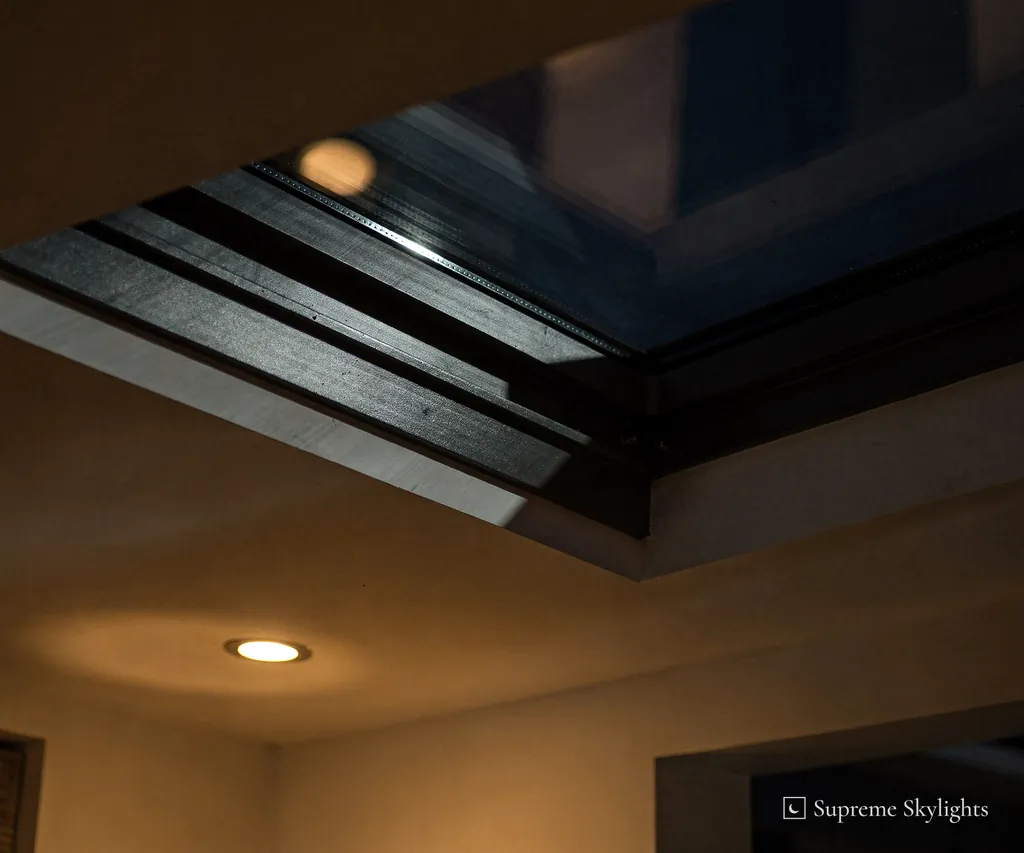
By five in November the daylight has gone, and a flat-roofed extension is lit by whatever hangs from its own ceiling. A rooflight over it spends those evenings as a dark pane that mirrors the room. In daylight the same pane is the reason the room can be used without the lights on at all.
The older units are the replacement question. A flat rooflight installed decades ago may have a dated frame or a worn seal, and the upstand it sits on is one of the parts to look at. The 2.2 limit covers the kerb as well when the kerb comes with the unit as a single assembly from the same supplier. An upstand built on site should be no worse than 0.35 W/m²K.
The kerb is part of the energy picture. For a rooflight on a newly built extension, the extension's own assessment covers it, and North Somerset Council confirms the position before any work starts. Fitted into an existing flat roof, it is a roof alteration with limits of its own, which the planning guide sets out.
Whether the unit fixes or opens is the next choice. A fixed unit is simple and gives daylight. An opening one lets warm air out in summer, and an electric or solar version can work from a switch on the wall or a handset. Replacing a flat rooflight goes through what that involves.
The room below is where you feel the result. A new unit with a clean lining and a blind that closes completely turns a cold November evening into a room that feels enclosed, and the same glass in July can be opened wide.
Nailsea, answered
Can you replace a misted roof window at a house in Nailsea?
Both are ours, new sealed glass or a whole new window. The frame settles which, and misted rooflights goes through how that is worked out.
How does Nailsea Kingshill affect a rooflight job?
Alone, it leaves the right to put a rooflight in a house roof where it was. A council Article 4 direction can remove that right, and so can a planning condition, so North Somerset Council gets the address before any work. Our planning guide's section on England gives the full rules.
What U-value should a replacement roof window have?
A replacement roof window should meet Band B on the Window Energy Rating, or a U-value no worse than 1.4 W/m²K. A rooflight has its own figure, 2.2 W/m²K.
Which council decides listed building consent in Nailsea?
North Somerset Council, as the local planning authority. Applying costs nothing, and a listed house is found by searching the National Heritage List for England.
Where does the free survey start?
An email to info@supremeskylightsnewport.co.uk or a WhatsApp to 07880 284133 gets it started. Give the address and say which window is misted. A visit happens before any price, and the price then arrives as a fixed written quote.
Do you deal with the Building Regulations paperwork?
We handle the Building Regulations notification where the work is notifiable, with the council's building control team or a registered building control approver.

Book your free survey
10-year workmanship guarantee.
Building Control notification handled where notifiable.