
Ynys-ddu, Caerphilly county borough: west of Newport, 11.4 road miles by road
New rooflights and skylights in Ynys-ddu
- 10-year workmanship guarantee
- We handle the Building Control notification where notifiable
The Ranks and their plots
Ynys-ddu is a small village in the Sirhowy valley, founded in the early 19th century by the colliery owner John Hodder Moggridge, who lived at nearby Woodfield Park. The Ranks, founded as a social experiment, allowed a few workers to lease a plot of land to build a cottage and a garden allotment. The name joins two Welsh words, 'ynys' for island or river meadow and 'ddu' for black, and it is about 10 minutes by road from the M4 and 20 minutes from the Second Severn Crossing. Put together, the two words give 'black river meadow', a name held to suit the landscape of the area. Caerphilly County Borough Council is the planning authority.
Roofs vary with the age of a house. Older cottages and terraces are often roofed in slate or tile, later homes more often in concrete tile, and a rear addition may have a flat roof. We look at the roof in front of us before we suggest anything, and what lies under it settles the choice.
| What you have | Where the problem shows | A route worth costing |
|---|---|---|
| Flat rooflight gone cloudy | Mist trapped inside the glass | A new sealed unit, or a whole replacement rooflight |
| Cold, draughty old roof window | Condensation on the sash after dark | A modern roof window of the same size |
| Extension roof with little daylight | A dim middle to the room | An energy-efficient flat rooflight over the room |
| Cottage loft used as a bedroom | Early light and a dark winter evening | A roof window and a lined blind for the dark |
Misted units, cold glass and old roof windows

11:00
Caerphilly County Borough and Wales's rules
Planning in Ynys-ddu is dealt with by Caerphilly County Borough Council. Wales sets its own permitted development rules for householders, and they differ from England's. A rooflight in the roof of a house may be covered by them, subject to conditions in the planning guide's chapter on Wales, including the places where the rules stop applying.
Flats have no householder permitted development rights. Rights can be taken away through an Article 4 direction, or through a condition attached when the house first received planning permission. For a doubtful case the council's planning team can say, and a Lawful Development Certificate would put the answer in writing.
A listed house needs listed building consent for work that would affect its character. That consent comes from the local planning authority. The list is compiled by the Welsh Ministers, on recommendations from Cadw.
12:00
Villages near Ynys-ddu
A flat rooflight gone cloudy
Replacing the sealed unit, or the whole rooflight.
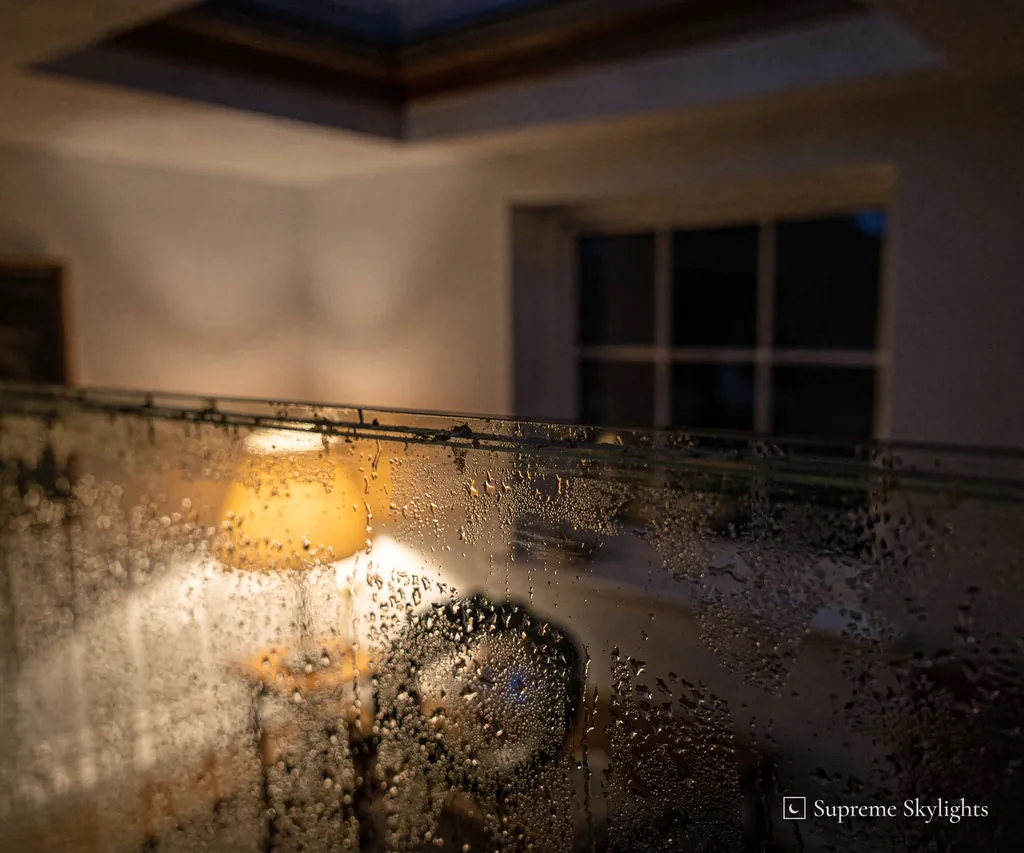
Is there a grey haze between the panes of your flat rooflight that no cloth will reach? That is a misted unit. Moisture sits inside the sealed glass, where it cannot be wiped off, and on a bright morning it shows as a milky patch across the ceiling.
There are two ways to put it right. The first is a new sealed unit in the frame already on the roof. The second is a whole new rooflight, frame and glass together. Which one fits turns on how the frame is holding up, and the kerb underneath it, and that is judged from the roof itself, with the glass, the seals and the edges all in view. The comparison of sealed unit or whole rooflight sets out how the choice is made.
Size and shape are measured at the survey, and the replacement is ordered to match. A flat roof's covering is noted too, so that a new kerb or upstand can be dressed into it. If you can send details of what is up there already, any marks on the frame or a label inside the glass help. Rainclear advises a kerb sloped at no less than five degrees for its flat glass rooflights, to minimise water pooling, and the kerb is measured with that kind of advice in mind.
Moisture inside a unit says nothing about how the rest of the roof is doing, which is why the survey looks past the glass. The flashings, the kerb and the ceiling lining beneath are looked at alongside the glass.
Replacing only the glass while keeping the existing frame is not building work for the energy rules. A whole new rooflight is different: Approved Document L (Wales) is guidance, and it says that a replacement rooflight in an existing home should have a U-value no worse than 2.2 W/m²K.
Cleaning is another consideration for a roof you cannot reach. Roof glazing is among the listed uses of Pilkington Activ, a self-cleaning glass whose coating works with daylight and rain to shift dirt.
Where a whole rooflight is replaced, the notification is something we handle with local authority building control or a registered building control approver, where the work is notifiable.
| Route | When it comes up |
|---|---|
| New sealed unit | The frame and kerb look sound at the survey |
| Whole rooflight | The frame or the kerb is the weak part |
Cold glass over a warm room
Glazing choices for an extension roof.
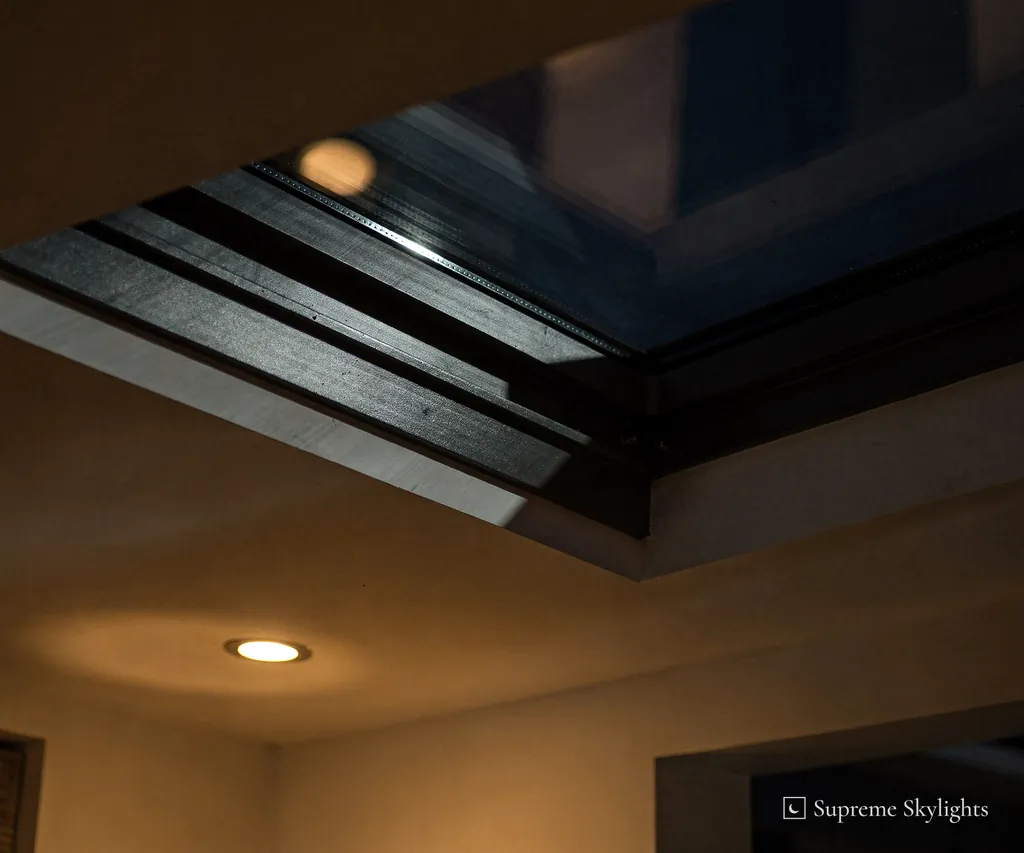
Compare the glass before you compare the frames. On a winter evening the rooflight over an extension can be the coldest part of the ceiling, and it is where the room's warmth meets the night. The glazing decides how that meeting goes.
Double and triple glazing are both on offer. VELUX's flat and curved glass rooflights come in double or triple glazing, and the maker credits that glazing with enhanced energy efficiency and sound reduction. The standards are guidance rather than a rulebook: Approved Document L (Wales) says a rooflight should meet 2.2 W/m²K and a roof window 1.4 W/m²K or Window Energy Rating band B. Our page comparing double and triple glazed rooflights goes through the trade-offs.
Another detail in the guidance: a rooflight is measured by its whole developed surface, which can be larger than the hole in the roof. A kerb supplied as one piece with the rooflight falls under the 2.2 limit as well.
The room itself deserves a thought. After dark, glass over a kitchen or a family room turns black and returns the lamp light, so a rooflight that is well proportioned to the ceiling looks settled, while one that is too small looks like an afterthought. We talk through the proportions at the survey, with the lining and the position in view.
A home's use of the room matters here too. A kitchen extension used morning and evening makes different demands from a spare room used for storage, and the glass can be matched to the use. What the room below is used for guides the glass: how many hours it is occupied, how much steam it sees, and how it is heated.
Size matters for the lining too. A deep reveal makes a rooflight look smaller from below, and a shallow one lets the glass fill more of the ceiling. We note the depth of the roof build-up at the survey, and the plasterboard return is planned from it.
Opening glass changes the picture again. A rooflight that opens lets kitchen steam out. An electric opening rooflight can be worked by a switch or handset, which suits glass out of reach over a worktop or a dining table.
The old roof window that streams at night
Swapping a tired VELUX for a modern one of the same size.
By the first cold week of autumn, an old roof window can run with water on the glass when the room is warm. Water on the inner pane at night is condensation. The remedy can be a replacement in the same opening, which avoids cutting a new hole in the roof. Where a house has more than one roof window, each can be looked at on the same visit, and the ones still working well can stay.
To match the size, open the window and read the small metal label across the top of the sash. VELUX sets each size code against a width and height, for example MK04 at 78 by 98 cm, and every VELUX window made after 1968 carries a sign. Send us the code or a clear photograph of it, and the replacement can be lined up before the survey.
Swapping the whole window for one the same is building work, whereas a repair is not. Changing just the glass, with the frame left in place, is something the energy rules do not count as building work. Our page about VELUX size codes shows how the codes read, and the walkthrough for replacing an old skylight explains the route.
Brightness can be the reason for asking. A replacement that fits the old opening keeps the view and the position, which suits a room that works well already and is let down only by tired glass. Those who want a bigger window are looking at a different job, since a larger opening usually means altering the rafters.
Ventilation counts as part of the change. Approved Document F (Wales) asks that a replaced window leave the home ventilated at least as well as before, and any background vents the old window had should be matched by vents of at least the same size, controllable by the occupant or automatically.
The sash itself is a choice. The glazing options VELUX lists include a dirt-repellent coating, laminated safety glass on the inner pane, and a rain noise reduction build, and which are available varies by window and variant.
Same-size swap, roof window
- Size from
- The code on the type sign at the sash top
- What changes
- The glass and the sash; the opening stays
- Air
- Vents no smaller than the old window's
- Paperwork
- Notified where the work is notifiable
Roofs and rooflights in Ynys-ddu
What does a misted rooflight need?
Either a new sealed unit in the existing frame or a whole new rooflight. Which one depends on the condition of the frame and the kerb, which we look at on the roof. Our misted rooflight page explains both routes.
Where is Ynys-ddu in relation to Newport?
West of Newport, 11.4 road miles away, in Caerphilly county borough. The survey is free.
Can I replace an old roof window without altering the roof?
Often, yes. Where the opening is sound and a unit of the same size is made, the new window can go into the existing opening. The code on the sash-top label speeds things along.
Does a new rooflight need planning permission?
On a house in Wales, it can be permitted development when it meets the conditions in the Wales chapter of the guide. Flats have no householder rights. Caerphilly County Borough Council can confirm a doubtful case.
Who decides on a listed house in this area?
Listed building consent is applied for through Caerphilly County Borough Council, and it is needed where the work would affect the building's character. Compiling the list falls to the Welsh Ministers, who act on Cadw's recommendations. On a listed building Cadw says replacing traditional windows with uPVC will not normally be acceptable.
How should I get in touch to book?
The survey form is quickest. WhatsApp (07880 284133) and email (info@supremeskylightsnewport.co.uk) reach us as well.

Book your free survey
10-year workmanship guarantee.
Building Control notification handled where notifiable.