
Reached from Newport after 21.4 miles by road, heading north-west
Skylights and rooflights fitted in Bargoed
- 10-year workmanship guarantee
- We handle the Building Control notification where notifiable
Market town, colliery, country park
Bargoed sits in the Rhymney Valley, one of the South Wales Valleys, on the Rhymney River, in the county borough of Caerphilly. The Welsh name is Bargod, and it counts as both a town and a community. It began as a market town and became a substantial one once a colliery opened in 1903. That colliery, which L. S. Lowry painted, closed during the 1970s, and its former site is now a country park. Wooden sculptures of mine workers stand in the park, and in Hanbury Square three immense heads of colliery workers dominate the piazza. By road, Bargoed is 21.4 miles from Newport, to the north-west.
Roofs differ by decade. Older terraces and villas tend to be pitched in slate or tile, houses built after the war often carry concrete tile, and extensions of any age may be flat. We look at what is overhead room by room, because the simplest daylight is the one that fits the roof you have.
| Home | What is above | Glass to weigh up |
|---|---|---|
| Terrace with an ageing roof window | A pitched slope with a window already in it | A like-for-like swap into the existing opening |
| Semi with a kitchen or family-room extension | A flat roof at the back | Lantern or flat-roof glass |
| Older house with a draughty loft room | A pitched slope with thin glazing | A newer roof window with better figures |
| Bungalow with a dim inner hall | A low pitch over a loft void | A roof window, or a tube for the hall |
Three jobs these houses bring up


11:00
Caerphilly's say and the Welsh rules
Bargoed falls under Caerphilly County Borough Council for planning. Whether a rooflight in a house roof can proceed as permitted development in Wales, and the limits that go with it, are explained in our guide to the Welsh planning rules.
Planning and building control are two separate tracks, and a job can be fine on one and still need the other to look at it. Building control is its own track. Where the work is notifiable, we handle the notification, which goes to local authority building control or to a registered building control approver. In Wales, approval under the Building Regulations is generally needed when a rooflight is newly installed.
Permitted development does not cover flats or maisonettes. A listed house is different again: work that would alter its character as a building of special architectural or historic interest calls for listed building consent, which is applied for through Caerphilly. Cadw puts buildings forward for the list, and the Welsh Ministers compile it.
12:00
Close to Bargoed on our list
An old VELUX in the back bedroom
Swapping a tired window, and what to read off it first.
Think about the room before the window. A back bedroom slept in by a teenager who rises at noon wants a blackout blind, and a landing wants none, so the same opening can lead to two quite different orders. Then open the old VELUX and run a hand along the top of the sash. A metal type sign is fixed there, as it is on every VELUX window made after 1968. It carries the size code, and VELUX's published size list gives the dimensions that go with it. Sending a picture of it ahead of the visit removes the guesswork about the opening.
Why start there? Because a replacement can often go into the existing opening when the hole in the roof is sound and the new window is the same size, and that keeps the structural work down. A bigger window usually means cutting rafters and trimming around them, which is a different job.
The Building Regulations draw a line here. Swapping one window for another of the same kind is building work in their eyes, but mending an existing one is not. A glass-only change, with the old frame kept, does not count as building work where the Welsh energy rules are concerned. Where our job is notifiable, we handle the notification with local authority building control or a registered building control approver.
A new window is also a chance to change the glass. VELUX offers variants with an easy-clean surface, an inner pane laminated so that broken glass is held back from the room, and quieter glazing for rain noise. Which of those you can have depends on the model and variant. Rain on a slope can be heard in a back bedroom, so the quieter glazing is worth asking about if the room is slept in.
Air is the other thing to keep in step, because a replacement should not leave the home less well ventilated than before. That is why we note any vents on the old window before it comes out. Blinds are settled at the same sitting, and the size-code explainer shows how the list is laid out.
A lantern over the family room
Pitched glass on the back of the house, and what it does after supper.
Where does the light land in your extension at four in the afternoon? In a deep room, with the garden doors at one end, the answer can be the table nearest them and little else. A roof lantern fixes that by putting glass above the middle of the room, not at its edge.
A lantern is only as good as the room beneath it. The depth of the roof structure is measured at the survey, because a deep ceiling opening shows the shape off from inside, while a shallow one leaves less room for it. A lantern has pitched glass on a base that rises from the flat roof, so it stands taller than a flat rooflight and gives the ceiling beneath it more height and shape. Brett Martin's installation sheet for its roof lantern specifies a builder's upstand of a stated minimum height, and recommends building it level. The lantern tolerates up to 5 degrees of pitch, though Brett Martin warns that it will likely look lopsided. This is guidance from one maker, for its own lantern, so what applies to yours comes from the product we suggest. The lantern planning and Building Regulations guide covers the rules. For a lantern on an extension still to be built, Caerphilly is asked about its status before work starts.
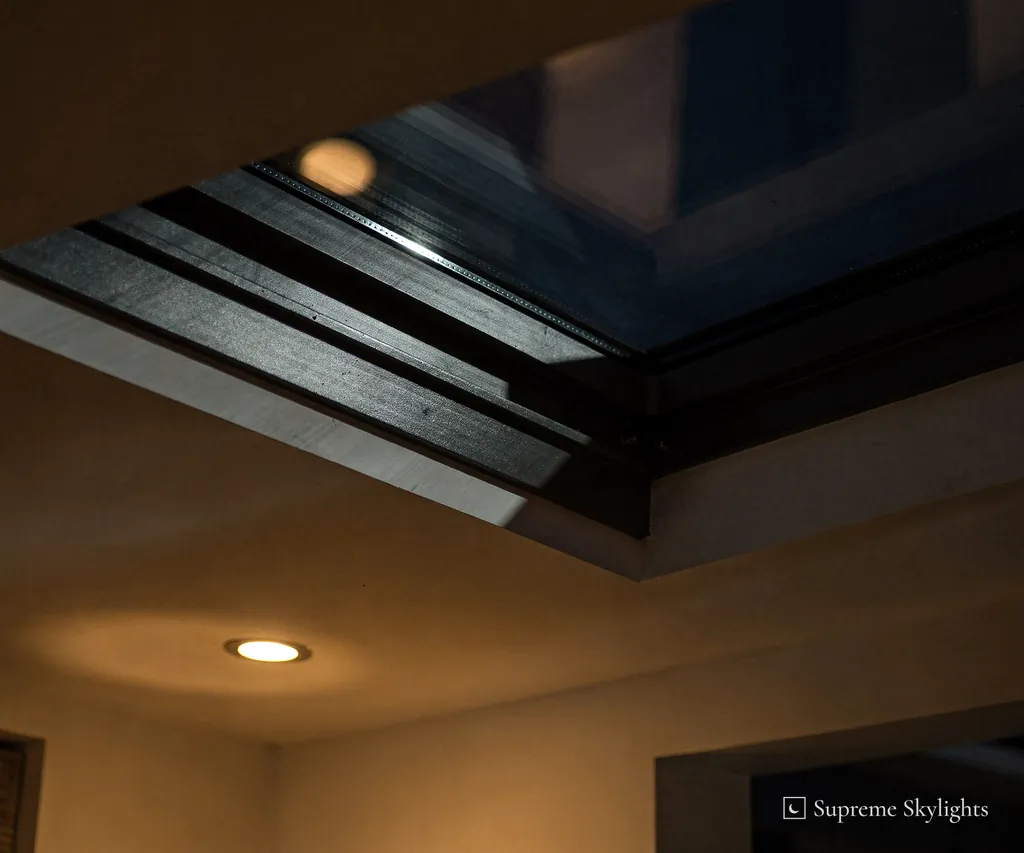
What about after supper? With the lights on and the sky black, a lantern turns into a dark mirror, and the room is reflected in every pane. The reveal inside, the plasterboard that lines the opening, decides how that looks, since a neat one reads as a calm shape and a rough one as a gap. A lit strip in the reveal would be wired before plastering, so if it is wanted it has to be known early.
The same glass that brightens the room in March can warm it in July. Whether that matters depends on which way the roof faces, so the survey includes standing in the room and noting where the sun comes from. Think too about who looks up at it. From a bedroom window above the extension, the lantern's ridge is in plain view, and its shape is part of what the house looks like.
Lantern, family room
- Stands
- Taller than a flat rooflight, with pitched glass
- Sits on
- An upstand following the maker's details
- Lining inside
- A plasterboard reveal, shaped at the survey
- For a new extension
- Planning status confirmed with the council
The figures behind a warm room
What Welsh guidance says about roof windows and rooflights.
February is when thin glazing gives itself away. A cold pane in the slope drains warmth from the room beneath, and condensation can show at its edges. The numbers that describe this are U-values, in W/m²K, and lower is better.
Approved Document L (Wales) is guidance, and its wording is that a new or replacement roof window in an existing home should have a U-value no worse than 1.4, or a Window Energy Rating of Band B. A rooflight should have a U-value no worse than 2.2. The two figures are for different things, so a roof window is held to 1.4 and a rooflight to 2.2, and neither number is a promise about a particular product until the maker's own figures are in front of you.
For a rooflight, the calculation runs across the unit's full developed surface, which can exceed the opening cut in the roof. A kerb that arrives as one piece with the rooflight falls inside the 2.2 limit as well.
Two of our pages work through the detail: how Part L treats rooflights in Wales and what counts as a good U-value.
When a maker quotes a figure, ask what it describes: the glass alone, or the whole unit with its frame. The two are not the same number, and the whole-unit figure is the one that describes the finished window. A rooflight with a very low glass figure can still disappoint if its frame leaks warmth, and a window with a modest figure can do well in a room that is aired properly. Look at the comparison sensibly. A figure only tells you about the glass and frame it describes. How the window is fitted and flashed, and whether the room has a way to clear moisture, decide how the room feels in a cold week. The survey comes before any price, and what follows it is a fixed written quote.
| Fitting | U-value, W/m²K | Wording |
|---|---|---|
| Roof window | 1.4, or Window Energy Rating Band B | Should meet |
| Rooflight | 2.2 | Should meet |
Bargoed bookings and basics
Does the free survey reach Bargoed?
It does. Driving north-west from Newport, you reach the town after 21.4 miles, which falls within our 30-mile range, and the survey is free.
Which council deals with planning questions in Bargoed?
Caerphilly County Borough Council. It is also where an application for listed building consent would go, for a listed house. Our planning guide has the Welsh rules.
What do I look for on an old VELUX before you visit?
The sash top, where a metal plate shows the size code once the window is open. A photo of it helps us see which replacement fits the existing opening, and VELUX windows made after 1968 all carry one.
How is a lantern different from a flat rooflight?
Shape and height. A lantern rises from the roof on pitched glass, where a flat rooflight stays close to it. The room, and the structure beneath, decide between them.
Will a new rooflight meet the Welsh energy guidance?
That is what the figures are for. Approved Document L (Wales) says a roof window should meet 1.4 W/m²K or Band B, and a rooflight 2.2 W/m²K. We set the product against those numbers, using the maker's own figures for the window or rooflight in question.
How do I get a survey booked for a Bargoed home?
Complete the survey form, or write on WhatsApp to 07880 284133, or send an email to info@supremeskylightsnewport.co.uk. Tell us the room that wants more daylight.

Book your free survey
10-year workmanship guarantee.
Building Control notification handled where notifiable.