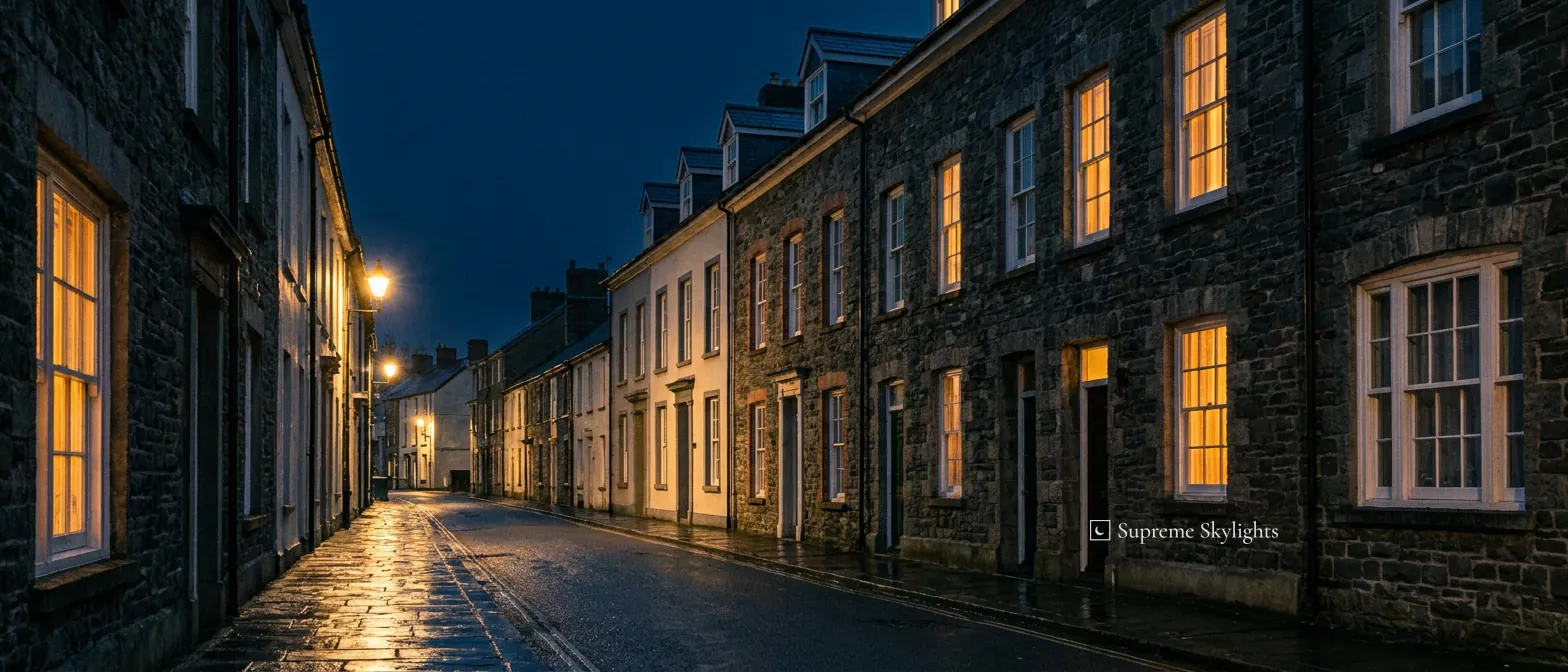
Monmouthshire town of Chepstow, 17.5 road miles east of Newport
New skylights and rooflights in Chepstow
- 10-year workmanship guarantee
- We handle the Building Control notification where notifiable
Houses on a slope above the Wye
Chepstow (Cas-gwent in Welsh) is a town in Monmouthshire. Its historic centre occupies part of a bend in the River Wye, and slopes up from the river to the town centre and beyond. Many buildings in the town remain from the late 18th and early 19th centuries, and one example is Castle Terrace, a row of bay-fronted terraced houses built in about 1810 on Bridge Street, the road leading down to the Castle.
Terraces of that age often have a pitched roof over a narrow plan, with a lower addition at the back where the kitchen or bathroom was later fitted. Homes of other ages sit alongside them, each with its own roof. The survey reads the roof over the room being changed, and in a town like this it also asks what the building's history means for the work.
The town developed rapidly after the Severn Bridge opened in 1966, replacing the car ferry between Beachley and Aust and allowing easier commuting to larger centres including Bristol and Cardiff.
| Building | Roof above the room | First thing to price |
|---|---|---|
| Terrace from the decades either side of 1800 | Pitched main roof, sometimes with a lower addition | A roof window set into the back slope |
| Period house in a conservation area or listed | Traditional covering that is to be kept | A conservation rooflight, once the planning route is clear |
| Kitchen or dining extension | Flat roof | A roof lantern over the table |
Conservation rooflights, roof windows and lanterns for Chepstow


11:00
A conservation area, a castle and the Welsh rules
Monmouthshire County Council takes the planning decisions for Chepstow, and its conservation area appraisals list one for the town. In Wales, a house inside a conservation area has no permitted development right for a rooflight in its roof slope, so it needs a planning application; our planning guide for Wales has the detail. Only a house inside the boundary is caught, and the council can confirm where it runs.
Chepstow contains five Grade I listed buildings and several at Grade II*. Work that would affect a listed building's character needs listed building consent, applied for through Monmouthshire. A flat has no householder rights of this kind, and an Article 4 direction or a condition imposed when the house was first approved can take them away from a house.
12:00
Towns and villages near Chepstow we also fit
A period roof among listed neighbours
Conservation rooflights and the questions that come first.
Chepstow holds five Grade I listed buildings: the Castle, the Priory Church, the Town Gate, the Port Wall and the Old Wye Bridge. Several more carry Grade II* status. In a town with a record like that, a roof job begins with questions about the building, well before any glass is chosen.
Three come first. Is the house listed? Does it stand inside a conservation area? Would the new glass change how the roof reads from the street? The answers sit with different bodies, and it saves time to know which is which.
On listing, Cadw publishes each listed building record in Cof Cymru, and listed building consent is needed in Wales where work would affect the building's character. Consent reaches interior details too, with historic fixtures and fittings among them, and small changes can need consent too. Cadw notes that replacing traditional windows with uPVC on a listed building will not normally be acceptable. Skipping the consent can amount to a criminal offence, which fixes the order of events: consent first, then the glass.
On conservation areas, a rooflight in the roof slope of a house inside one is not permitted development in Wales and needs a planning application (the Welsh section of the planning guide covers it). The test is the boundary, so a house a street away may be free of the rule while its neighbour is not.
For roofs of this kind, the product group is the conservation rooflight. If the name is new to you, what a conservation rooflight is is answered on its own page, and the planning side is on the guide to listed building consent for rooflights in Wales.
Earlier alterations are worth noting before the survey. A dormer, a rear extension or an existing roof window shows what has been built on the house before, though it does not promise that another change will be accepted.
Whatever the planning answer turns out to be, a rooflight counts as building work for the Building Regulations. Where the work is notifiable, we handle the notification with local authority building control or a registered building control approver.
| Question | Where the answer sits |
|---|---|
| Is the house listed? | The record in Cof Cymru, published by Cadw |
| Is it inside a conservation area? | The boundary, checked with Monmouthshire |
| Does the work affect a listed building's character? | Listed building consent, through Monmouthshire |
Who can see into a bathroom roof window?
Privacy, steam and reach on a street that climbs.
Can the neighbours see in? On a sloping street, it is a fair question. The roofs of one row can look across at the upstairs windows of the row above, and a bathroom lit at six in the evening is easy to see into from there.
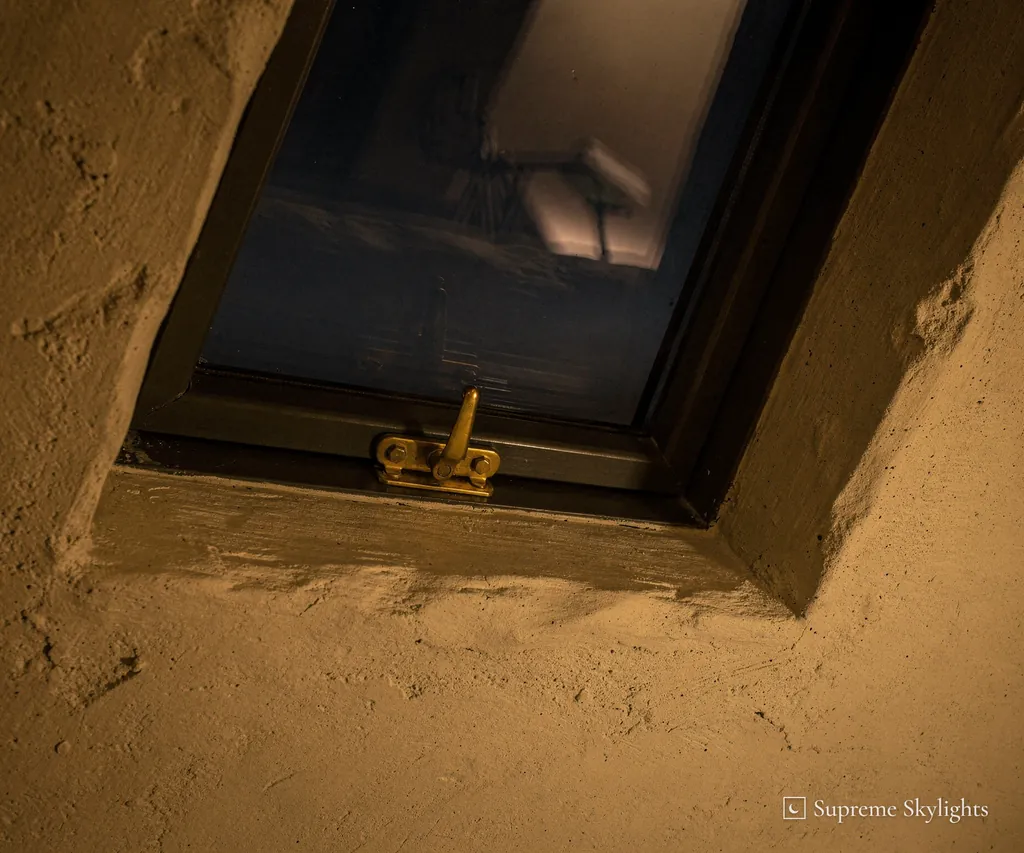
Seen from outside in daylight, a roof window looks at the sky and is seldom overlooked. After dark it is different. With the lamp on and the sky black, the glass behaves like a mirror from inside and a lit panel from outside, which is why the blind is part of the decision and not an afterthought. Standing at the planned position during the survey, and looking at what has a line of sight to it, settles more than any catalogue does.
Steam is the other half. Water vapour can find the glass first, because the roof window can be a cold surface in a warm room, and drips can land on the sill if nothing clears the air. A sash that opens is the simplest answer, and Approved Document F (Wales) points the same way for replacements: a swapped window should leave the home's ventilation no worse than before.
Height is the third. A bathroom slope can put the window above the tub or beyond the washbasin, out of easy reach. An electric roof window can run from a switch or a remote. Only VELUX's solar and electric roof windows carry its built-in rain sensor, and on those the sensor shuts the window for itself once rain starts.
On energy, Approved Document L (Wales) is guidance, and it says a new or replacement roof window in an existing home should have a U-value no worse than 1.4 W/m²K, or a Window Energy Rating of Band B.
The glass itself has options. VELUX's glazing options include a coating that repels dirt, safety lamination for the inner pane, which keeps glass from falling into the room in an accidental breakage, and rain noise reduction. Which are available depends on the window and the glazing variant, so they are chosen from the maker's list for the window you pick.
Replacing an old roof window in its existing opening can be a smaller job than cutting a new one, and how to replace an old skylight explains the difference.
An evening in the bathroom
- 17:15Last of the daylightThe sash is open to clear the steam.
- 19:30Lamp onThe glass turns black and mirrors the room.
- 21:45Blind downThe panel disappears from the street's view.
- 23:10Everything offA cold pane collects what steam is left.
Start with the upstand under the lantern
A roof lantern over a dining table, and the maker's advice.
Start with the upstand. Brett Martin specifies a builder's upstand for its roof lantern, and how that lantern looks depends on the upstand being right.
Brett Martin calls for an upstand of 150 mm or more, built by the builder, and recommends building it level, at 0°. Its lantern can take a pitch of up to 5°, though the maker cautions that the result will probably look lopsided. These are one maker's numbers and its advice for its own lantern, nothing wider.
The room under it matters just as much. A lantern over a dining table is the brightest thing in the room by day, and by evening it is the darkest. With a lamp on below, the glass is a black frame holding the room's reflection, and a plain, square lining around it looks calm where a crooked one looks like damage. The shape of the opening is talked through at the survey, well before plastering.
Comparing a lantern with a flat rooflight is a sensible first step, and the page on lantern or flat rooflight does it. A flat rooflight keeps a lower line from the garden. A lantern stands taller and gives the ceiling more height.
Cleaning is the practical afterthought on a roof that is hard to reach. Self-cleaning glass is one answer. Pilkington's Activ range carries a coating that relies on daylight to loosen dirt and on rain to rinse it off. Whether it suits a given lantern depends on the product.
For a lantern built into a new extension, the planning route is not settled by a simple rule, so we confirm it with Monmouthshire County Council before work starts. A lantern on an older flat roof gets the same council conversation.
If the lantern is replacing an old one, the page on replacing a roof lantern sets out what that involves.
Lantern upstand, Brett Martin's advice
- Height
- An upstand of 150 mm or more, built by the builder
- Level
- Built level, at 0°, is recommended
- Pitch
- Up to 5°, which the maker says will probably look lopsided
- Planning
- Confirmed with Monmouthshire for a new extension
What Chepstow households ask
What is the road distance from Newport to Chepstow?
It is 17.5 road miles, heading east, and the survey is free. A fixed written quote comes after it.
Chepstow has a castle and many listed buildings. Who decides on work to them?
Monmouthshire County Council, as the local planning authority, takes the application for listed building consent. The consent covers work that would affect the building's character. Cadw recommends what is listed, and the Welsh Ministers compile the list.
Is a back roof slope treated differently inside the conservation area?
The Welsh conservation area rule does not single out a slope. A rooflight in the roof slope of a house inside a conservation area is not permitted development, and it needs a planning application. The planning guide for Wales explains the rest, and the council confirms where the boundary runs.
Does a new roof window count as building work?
Yes. Building Regulations count a window, roof window or rooflight as a controlled item, so fitting one is building work. We make the notification to local authority building control or a registered building control approver, where the work is notifiable.
How does a lantern work out on an extension?
Its planning treatment is a question we put to the council for confirmation. Brett Martin specifies a builder's upstand, at least 150 mm high, for its own lantern.
Where do Chepstow households start with a survey?
The survey form is the simplest place. WhatsApp on 07880 284133 and the address info@supremeskylightsnewport.co.uk both work, and it helps to name the room and the roof.

Book your free survey
10-year workmanship guarantee.
Building Control notification handled where notifiable.