
Cardiff, in the south-west: a 14-mile drive from Newport
Skylight and rooflight fitting in Cardiff
- 10-year workmanship guarantee
- We handle the Building Control notification where notifiable
Between the River Taff and Plasdŵr
Cardiff is the capital and largest city of Wales. The River Taff winds through the city centre and, together with the River Ely, flows into the freshwater Cardiff Bay. A widely used building stone in the city is the yellow-grey Liassic limestone of the Vale of Glamorgan, including the rare Sutton Stone, a conglomerate of lias limestone and carboniferous limestone. In 2017, plans were approved for a new suburb of 7,000 homes between Radyr and St Fagans, known as Plasdŵr. Cardiff Bay contains the Senedd building and the Wales Millennium Centre, and Welsh was the majority language in the city from the 13th century until its explosive growth in the Victorian era.
Cardiff Central is the largest railway station in Wales, with eight platforms coping with over 12.5 million passengers a year, and Queen Street is the hub for the Valley Lines services that connect the South Wales Valleys and the suburbs with the city centre. When completed, the A4232, also known as the Peripheral Distributor Road, will form part of the Cardiff ring-road system, along with the M4 between junctions 30 and 33.
Lisvane, Cyncoed, Radyr and Rhiwbina contain some of the most expensive housing in Wales, and Queen Street is the second busiest station in Wales. Roofs differ from one home to the next, so the first thing we do is read the one in front of us, from the slope or the flat deck to the timbers beneath it and the room that needs the glass.
| Where the room is | What is above it | Worth pricing |
|---|---|---|
| Attic or loft room in a house | Rafters and a pitched covering | A roof window, plus a blind for sleep |
| Kitchen or living room built on at the back | A flat roof | A rooflight or a lantern on an upstand |
| Landing, hall or bathroom with no outside wall | A pitched roof and loft space | A sun tunnel, where the loft allows |
| Passage, light well or flat roof used as a floor | Structure designed to be walked on | A walk-on rooflight |
Glass that answers those four situations

11:00
Cardiff Council and the Welsh rules
Planning applications in the city go to Cardiff Council. For a house, permitted development in Wales may cover a rooflight, within limits that our planning guide, Wales section explains.
Conservation areas can decide the matter. Cardiff's include Cathays Park, Cathedral Road and Tredegarville, among others. In Wales, a new rooflight in a house inside a conservation area is not permitted development, so it needs a planning application. The boundaries are on the Welsh Government's conservation area map, though only the council can confirm a particular address.
A flat has no householder permitted development rights. If a building is listed, work that would affect its character needs listed building consent, applied for through Cardiff Council, with Cadw recommending which buildings are listed.
12:00
Towns and suburbs beside Cardiff
Is your attic window meant to keep the heat in?
Roof windows and the Welsh energy figures.
Glass in a roof can be the coldest surface in an upstairs room in winter, and the first to fog. The Welsh guidance has numbers for it, written as what a window should reach.
Approved Document L (Wales) says a new or replacement roof window in an existing home should have a U-value no worse than 1.4 W/m²K, or a Window Energy Rating of Band B. A rooflight, which is a glazed unit set on a kerb or upstand, should be no worse than 2.2 W/m²K. The two products have different figures, and the table shows them side by side. The document names each product on its own terms.
Behind the figures there are choices, and the double against triple glazing guide weighs them. VELUX says its flat and curved glass rooflights come with double or triple glazing, for enhanced energy efficiency and sound reduction.
An attic room has another reason to take the glass seriously. Where a window mists up or drips overnight, a replacement that meets the guidance figures is worth pricing, and the survey shows whether the whole window or only part of it is the trouble.
For a replacement, the survey records the size of the opening, the rafters on either side, the covering and flashing, and the lining of the reveal inside. A window of the same size in the same opening avoids most of the structural work, whereas a larger one usually means cutting into the rafters and a different conversation about cost. Ventilation counts as well: Approved Document F (Wales) expects the airing of the home to be at least as good after a window swap as it was before.
A new roof window will generally need approval under the Building Regulations, and we handle the notification where the work is notifiable. The planning side is explained in the Welsh planning guide.
| Product | Figure to aim for |
|---|---|
| Roof window | 1.4 W/m²K, or WER Band B |
| Rooflight on a kerb | 2.2 W/m²K |
Glass you cannot reach to clean
Self-cleaning coatings and the high roof over a rear room.
Start with the ladder you do not own. A rooflight on a flat roof over a rear room is too high to wipe from inside and, in many gardens, awkward to reach from outside. Dirt, pollen and the summer's leaf fall settle on it, and the view of the sky gets smeared.
Self-cleaning glass is made for exactly that. Pilkington names rooflights as one application for its Activ coating, which works with daylight and rainwater to shift dirt. It is an option on some rooflights, so it is worth asking about for a unit that will sit out of reach.
Whether rain does the washing depends on the roof around the glass. For its own flat glass rooflights Rainclear advises a minimum of 5° of slope on the kerb to reduce pooling. That advice is Rainclear's, for its range.
Cleaning is half the story. The other half is the room the glass lights. Where a kitchen or a family room at the back of a house takes its daylight from the roof, a smeared panel dims it. A lantern shows more glass and so shows more dirt; a flat rooflight shows less. The lantern-or-flat guide weighs one against the other.
Where a unit opens, a switch can work it when the glass is too high to touch, and the electric opening rooflights hub shows what is on offer.
Tell us how high the ceiling is, what is on the roof around the glass, and whether trees overhang. Those three facts decide how much cleaning the glass will want, and what to ask the survey to look at.
Cooking brings a second wish list. A pan of pasta puts steam into the air, and glass over the hob or the sink is where it can show first, as a mist on the underside. A kitchen with a rooflight and a good extractor needs both to be considered together, so the extractor's route outdoors is something to mention when you ask for a price.
Walk-on glass over a passage or light well
What a floor-level rooflight does, and what it shows after dark.
A rooflight is made to keep the rain out, and a walk-on rooflight has to do that and take a footstep as well. It is a unit designed to be stood on, set into a flat roof or a deck, and it is the product for a passage, a light well or a roof used as a floor. A room below gets daylight through it while the space above stays usable.
Sizes and load ratings are the heart of the choice, and they are not something to assess by eye. How the figures are read is covered in the load ratings guide.
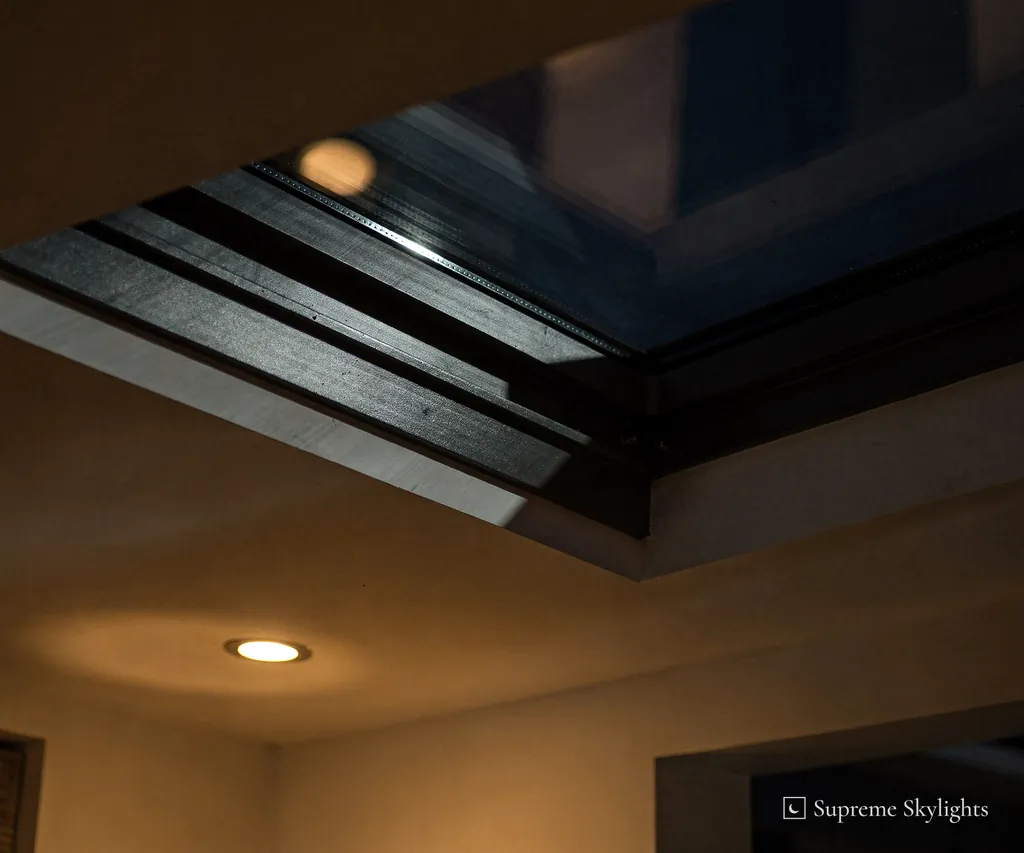
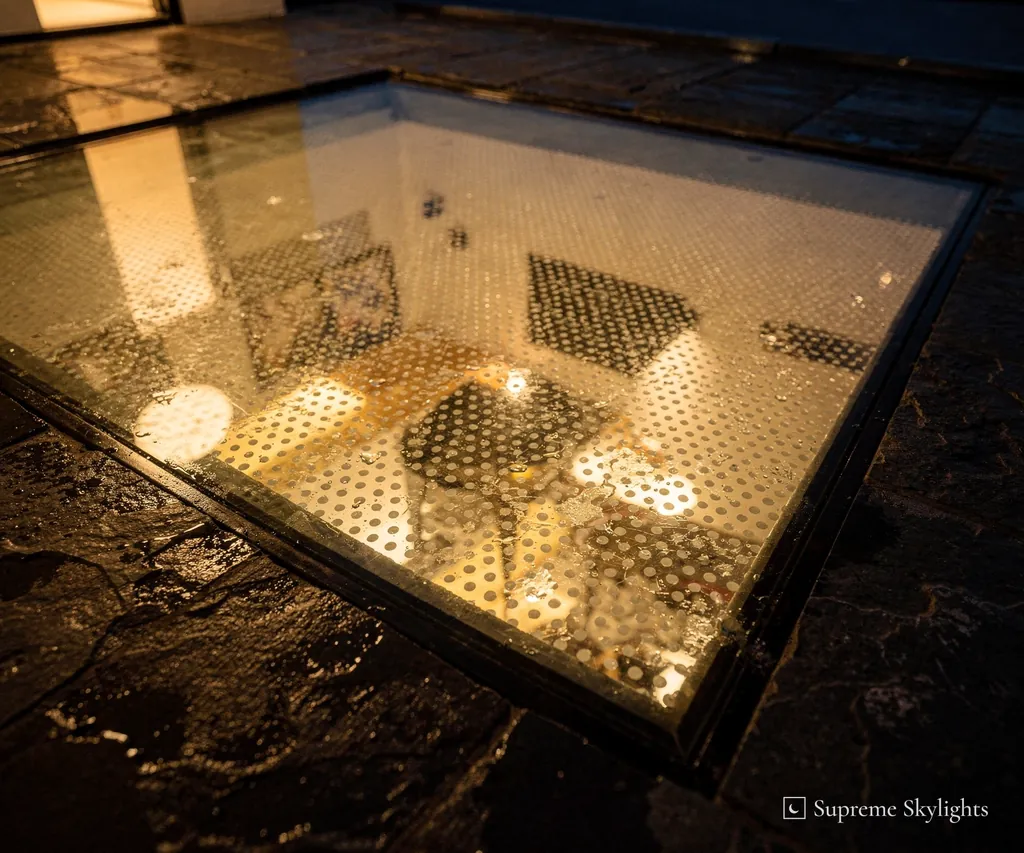
After dark the glass does something different. Looking down from above, a lit room underneath shows through the unit as a bright rectangle in the deck; looking up from the room below, it reads as black glass with the room reflected in it. Nothing in the glass gives out light; it shows only what the lit room beneath it puts there.
That is a reason to talk about positions early. A rooflight over a passage will be walked across daily, and the one over a light well will be looked down into from the window above. Where it sits is partly a matter of use and partly a matter of how the neighbours' windows see it.
In a city, planning is the other question. Householder permitted development rights do not reach a Cardiff flat or maisonette, whatever floor it is on. The walk-on rooflight planning answer sets out how the Welsh rules apply.
Think about use before size. A unit crossed every day by the household is a different order from one walked on once a year for maintenance, and a deck that children use asks for more thought. If you already have a passage or a deck in mind, send a photograph and the approximate size. A survey follows, and with it a fixed written quote.
One walk-on rooflight, one day
- 08:00MorningDaylight drops through to the room below.
- 13:00MiddayFootsteps cross the glass; the room stays bright.
- 19:00EveningGlass starts to mirror the lit room.
- 22:40NightFrom above, a lit rectangle; from below, black glass.
Cardiff homeowners ask
Roughly how far is the drive between our two cities?
By road Cardiff is 14 miles south-west of Newport. Surveys in Cardiff carry no charge, and the quote that comes after is fixed and written.
Which Cardiff areas have conservation area rules?
Cardiff's conservation areas include Cathays Park, Queen Street, St Mary Street, Windsor Place, Charles Street, Churchill Way, Cathedral Road and Tredegarville. The list runs wider than these. The Welsh Government's map shows the boundaries, and the council confirms any single address.
Can a flat have a new rooflight?
Householder rights under permitted development do not extend to a flat or maisonette. For what applies to a particular building, ask Cardiff Council before ordering anything.
What energy figure should a new roof window reach?
Approved Document L (Wales) gives 1.4 W/m²K, or Window Energy Rating Band B, as the level a roof window in an existing home should meet. The same document gives rooflights their own figure, so the two are compared separately.
Whose consent do I need if my Cardiff house is listed?
Listed building consent comes from Cardiff Council as the local planning authority, and it is needed where the work would affect the building's character. Which buildings are listed is decided by the Welsh Ministers, who take Cadw's recommendations.
Do you work in Penarth, Dinas Powys, Wenvoe and Tongwynlais?
We cover all four, and each has its own page. A survey in any of them is free, with a fixed written quote after it.
Where do I send a photograph of my roof?
Photographs can go to WhatsApp 07880 284133, or email info@supremeskylightsnewport.co.uk, or come through the survey form. Mention the address and the room.
Is there a guarantee on a Cardiff job?
Supreme Skylights gives a 10-year workmanship guarantee in writing, whichever product is fitted.

Book your free survey
10-year workmanship guarantee.
Building Control notification handled where notifiable.