
21 miles of road from Newport, heading north
Gilwern rooflights and skylights
- 10-year workmanship guarantee
- We handle the Building Control notification where notifiable
A village named for the bend of the alders
Gilwern takes its name from the Welsh Y Gilwern, from cil-gwern, the recess or bend of the alders, probably a reference to where the Clydach Gorge opens out into the Usk Valley and the River Clydach flows into a sharp bend in the River Usk. The River Usk and the Monmouthshire and Brecon Canal are close to the village. It is in Monmouthshire, 21 miles of road from Newport and north of the city, and inside Bannau Brycheiniog National Park.
We describe homes by type and age rather than by street. A cottage, a mid-century house and a recent extension each leave a dark corner in a different place, and a National Park setting adds a planning question to the usual ones about pitch, covering and timbers. The survey takes the roof first and the product second.
| Where it is dark | What is overhead | Product to price |
|---|---|---|
| Hallway of a flat-roofed extension | A flat roof on joists, with room below it | A walk-on rooflight, if the roof is to be stood on |
| Kitchen worktop far from the garden doors | A flat roof over the back of the house | A flat rooflight that opens by switch |
| Loft room in an older house | A pitched slope with the covering to be read on site | Roof windows and blackout blinds |
| Back bedroom that wakes early in summer | A pitched slope on the sunny side | A solar roof window with a rain sensor |
Glass for the flat roof, the kitchen and the loft

11:00
Inside the National Park: whose rules, and which?
Gilwern sits inside Bannau Brycheiniog National Park, so Bannau Brycheiniog National Park Authority is the planning authority here and Monmouthshire County Council is not. In Wales, a rooflight put into the roof slope of a house inside a National Park is not permitted development, and a planning application stands in its place. The Welsh part of our planning guide holds the full rules, with the National Park boundary layer showing the outline.
Flats and maisonettes are a separate case, since they have no householder permitted development rights. For a listed building, work that alters its character needs listed building consent, applied for through the Park Authority.
When you write to us, say whether the building is a house, a flat or a listed property. The three get different answers.
12:00
Around Gilwern, within reach
Glass you can stand on
Walk-on rooflights over a flat roof.
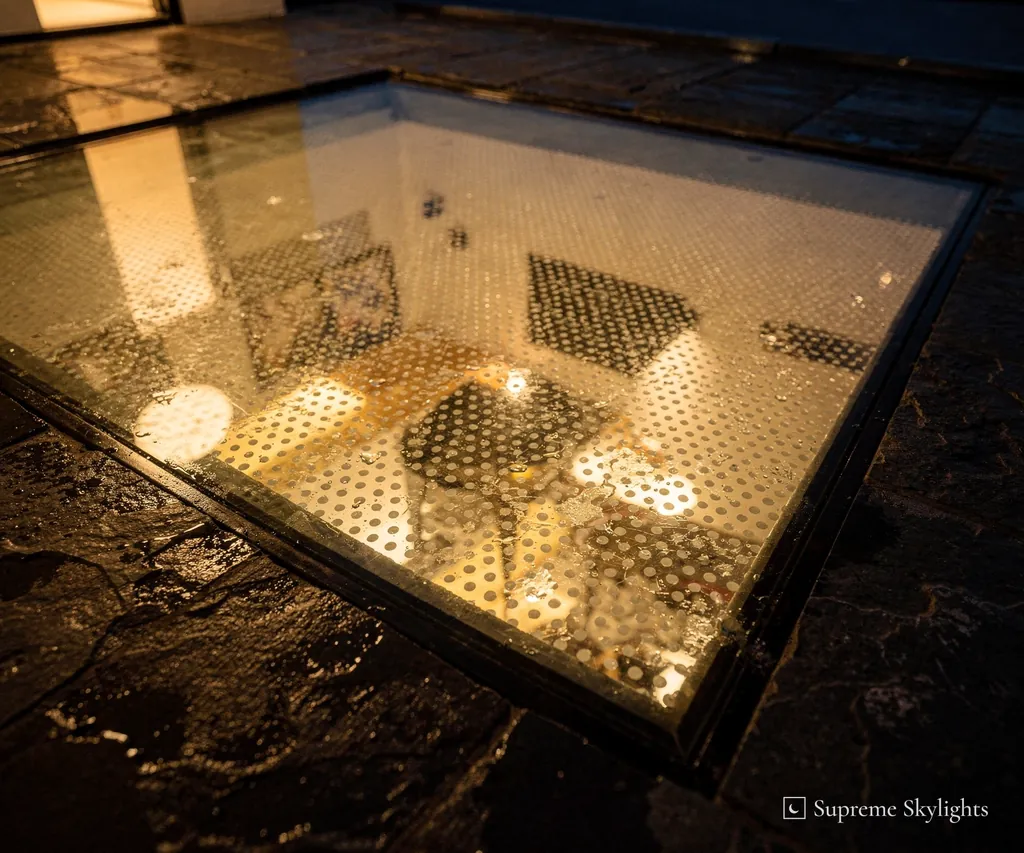
A walk-on rooflight is a pane of glass made to carry people, set into a flat roof so that daylight reaches the room below. It lets a roof be used as a place to stand, and a hallway or utility room beneath it gets light it would not otherwise see. Load ratings differ between products, and our page on walk-on glass load ratings explains how to read them.
After dark the glass reads differently from above and below. From outside, glass over a dark room shows very little. Over a lit room, the room shows through, and the lamp in the hallway becomes the brightest thing on the roof. Seen from inside at night, the pane overhead is a dark square that gives back the room.
Roof terraces change the planning picture. The gov.wales roof page makes the point that a rooflight which brings a roof terrace into being calls for planning permission, so a roof meant for standing on is checked before it is glazed. The limits on permitted development are laid out in our Welsh planning guide. In a National Park, any rooflight in the slope of a house roof already needs an application, so a walk-on pane is best discussed early.
The structure, the glass and its fixing are matters for the maker's data and the survey, and not for a rule of thumb.
What a survey can say is what the roof is made of and whether it was built to carry people. The opening has to be framed to carry the glass and whoever stands on it, which is a structural question answered on site.
Privacy works both ways with walk-on glass. A person standing on the pane can see into the room below, and anyone below can see up. That points to spaces where it suits: a stair hall, a utility room, a corridor between rooms. Over a bed it would be a poor match.
Think of the glass as part of the room's floor plan from above. The pane has an edge, and the room has furniture, so the two are best lined up on paper first. Moving a chair is easy; moving an opening in a roof is not.
The far end of the kitchen
An opening rooflight worked by a switch.
A kitchen that was extended toward the garden usually has one end far from the doors, and that end has the least light. The worktop, sink and hob often sit there, so the part of the room used most is the one that gets the smallest share of the day. A rooflight overhead puts daylight where the work is done.
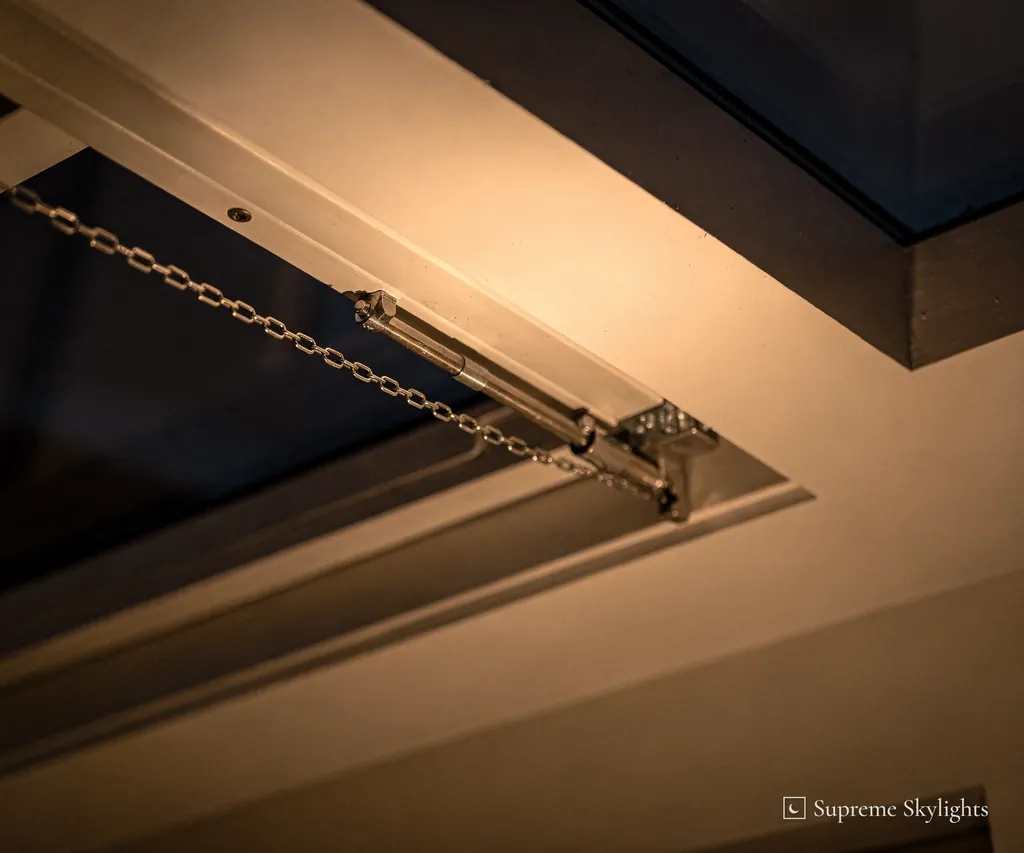
An opening version adds ventilation to that. The steam and cooking smells of a busy kitchen have somewhere to go, and in summer the room can be aired without opening the doors. A switch by the door can work the sash, and a unit out of reach above a worktop no longer needs a pole. Our page on electric or manual opening rooflights sets the two side by side.
At night the rooflight turns black and holds a picture of the kitchen: the pendant lamps, the hob, the people at the table. Over a worktop that is a good moment for a tidy ceiling, since a plain, square lining makes a calm frame for the reflection, where a patched one is plain to see. The lining is something to discuss before plastering.
After the cooking is done, moisture gathers on the coolest surface in the room, and the glass can be that surface. An extractor to the outside deals with some of the steam, and the sash deals with the rest if it is opened.
Wiring is a job for an electrician, and it is best planned when the opening is decided. We handle the Building Regulations notification with local authority building control or a registered building control approver where the work is notifiable, and a new rooflight will generally need approval.
Where the opening goes is a matter of joists. A flat roof is built on timbers at set spacings, and the opening is easiest to frame when it works with them and not against them. The survey takes the thickness of the roof from deck to ceiling and the line of the joists, then the size and position are chosen together. A thick roof leaves room for a deep reveal, which suits a lantern or a generous lining.
Decide what the glass should light. Centred over the worktop it favours the cook; over the table it favours the family. In a long, narrow room two smaller units can serve both ends better than one large one, and the roof structure is what allows or prevents it.
| Hour | At the worktop | Overhead |
|---|---|---|
| 13:25 | Lunch preparation | Daylight on the worktop |
| 18:40 | Dinner on the hob | Sash open to clear the steam |
| 22:10 | Clearing up | Glass dark, holding the room |
A back bedroom in July
A solar roof window and the rain sensor.
July mornings begin early, and a bedroom in the roof catches the sun before anyone is ready for it. A blackout blind is half the answer. The other half is air, and a window that opens is the simplest way to freshen a room that has been shut up all day.
Leaving the window ajar overnight raises one worry: rain. Among VELUX roof windows, the solar and electric ones carry a built-in rain sensor, and the window shuts itself when rain falls. That belongs to those VELUX ranges alone.
Solar and electric versions are worked from a remote or switch, which suits a sill set high on the slope. Our page on electric or manual opening covers how the two kinds differ.
Position the window with the bed in mind. A roof window above the pillow can wake you at first light, and one at the foot of the bed lights the room without lighting your eyes. A blackout blind then handles the exceptions. In a National Park village, with a planning application needed for a new rooflight in a house roof slope, the position is also something to settle in advance.
Tell us at the survey which way the slope faces, who sleeps in the room, and whether the window is to be reached from a bed or a chair.
Blinds matter in July more than in any other month. For an early riser, a blackout blind takes the edge off the morning, and the blind and the window are best chosen as a pair.
Finally, think about reach. A window set high on the slope can be a stretch from the bed, and a remote or wall switch gets round that. If the room is for a child or an older relative, the controls deserve as much thought as the glass.
Tell us how the room is used in high summer. A study that gets hot at the desk, a child's room that needs dark by eight and a guest room used twice a year each want something other from one slope, and the answers decide how much the window should open and what the blind should do.
A bedroom window in July
- Early light
- Blackout blind, picked with the glass
- Air at night
- An opening sash
- Rain while open
- VELUX's sensor, on solar and electric windows only
- Position
- Set with the bed in mind
Gilwern, in short answers
Who is the planning authority for Gilwern?
Bannau Brycheiniog National Park Authority, since the village is inside the National Park. Monmouthshire County Council does not take the applications here, though Gilwern is in Monmouthshire.
How do I reach you from Gilwern?
Gilwern is 21 miles of road from Newport, heading north, and the survey is free, with a fixed written quote after it. The survey form is the easiest start.
Is a rooflight in a Gilwern house roof allowed?
It needs a planning application, since permitted development does not cover a rooflight in the roof slope of a house inside a National Park. The Welsh planning guide explains the rule and its limits.
What about a listed cottage?
Listed building consent is needed where the work would affect the building's character, and it is applied for through the Park Authority. Cadw recommends which buildings are listed, and the Welsh Ministers compile the list.
Will a solar roof window close if it rains?
On VELUX solar and electric roof windows it will: VELUX fits those ranges with a rain sensor, and the window shuts once rain is detected.
Can I stand on the glass over my extension?
Only with a walk-on rooflight, and only where the roof is framed to carry it. Our page on walkable skylights explains the idea; the survey covers the structure.

Book your free survey
10-year workmanship guarantee.
Building Control notification handled where notifiable.