
Monmouthshire village, a drive of 10 miles from Newport, eastward
Skylights and rooflights for Undy homes
- 10-year workmanship guarantee
- We handle the Building Control notification where notifiable
Where the main line runs: roofs in Undy
Undy (Gwndy in Welsh) is a village in Monmouthshire. It adjoins the village of Magor, and together they form the community and parish of Magor with Undy. The main railway line passes through Undy, although there is no station now, and from 1941 it was doubled to four running lines, the outer two for slow goods trains serving the increasing wartime coal traffic. From Newport the village is 10 miles away by road, towards the east.
People have lived here for a long time: the area was first settled in Roman times, and in 1996 a stone coffin dating from the 3rd or 4th century was found during building work, containing the skeleton of a young woman. Today's building work is on a smaller scale. Houses of different decades can sit side by side in a village, from older cottages with steep slate or clay roofs to newer homes in tile with flat-roofed extensions added later, and the glass that suits each one differs. The visit starts from the roof you have, not from a standard answer.
| Housing | Cover overhead | First thing to try |
|---|---|---|
| An older cottage or terrace | Slate or clay tile, steeply pitched | A roof window cut into the main slope |
| A newer estate house | Concrete tile, with a flat-roofed addition | An energy-conscious flat rooflight on the addition |
| A single-storey rear extension | A flat roof around a raised edge | A lantern, if the ceiling height allows one |
| A hallway or utility with no outside wall | Whatever roof lies overhead | A small flat rooflight, or a sun tunnel if the loft is clear |
Glass for Undy extensions and roofs

11:00
Monmouthshire County Council and the Welsh rules
Monmouthshire County Council decides planning in Undy. Its published conservation area appraisals include one for Magor, the village next door. In Wales a rooflight added to a house inside a conservation area is not permitted development, but only houses inside a boundary are caught, so the answer for a particular Undy address comes from the council. Our planning guide for Wales lays out the rest.
Away from any such boundary, the guide sets the limits for a house, and the council's own directions, or a clause attached when the house was first permitted, can change them. Flats and maisonettes carry no householder rights of this sort. A listed house needs listed building consent for work that would affect its character; Monmouthshire receives the application. Cadw recommends what is listed, and the Welsh Ministers compile the list. When you want a position in writing, a Lawful Development Certificate from the council provides it.
Where the work is notifiable, we handle the Building Regulations notification with local authority building control or a registered building control approver.
Daylight for a hallway with no window
Small flat rooflights, and the energy figures behind them.
A lot of houses have a room buried at the centre of the floor plan: a hallway, a utility room, a downstairs toilet, a corridor to the garage. None of them has an outside wall, and none of them gets daylight unless the light comes from above.
Which product fits depends on what is overhead. Under a pitched roof with a loft, a sun tunnel can be the answer, because the tube runs through the void. Under a flat roof, or at the back of a house where an extension has been added, a small flat rooflight on its own upstand is simpler, since it sits straight over the room it serves. Our page on flat roof rooflights covers the sizes and the choice between fixed and opening.
Heat is the other half of the decision. Approved Document L (Wales) gives targets for glass in a roof, and they are targets, written as things that should be met. A rooflight in an existing home should have a U-value no worse than 2.2 W/m²K. A roof window has a tighter figure, 1.4 W/m²K or Window Energy Rating band B. The two rules apply to two different products, so a quote that mixes them up deserves a question.
Ask for the U-value of the unit as it will be built. It is a number you can compare, and it tells you more than a description of the glass does. Our page on Part L and rooflights in Wales sets the figures out at more length.
A small unit over a hallway can also do a second job. If it opens, it can let a damp utility room clear after the washing has been dried, and a switch or handset is easier than a pole when the glass is overhead. Whether the opening part is worth having is a question for the survey, because the room, the ceiling height and the position of the nearest light switch all feed the answer. Which of the three applies, a sun tunnel, a flat rooflight or neither, is settled by the roof, so the survey includes a look at it from outside and from the loft where there is one.
| Product | Should meet | Position |
|---|---|---|
| Roof window | 1.4 W/m²K, or band B | In the plane of the slope |
| Rooflight | 2.2 W/m²K | On a kerb or upstand |
A lantern over the dining end
Height, planning and the view from the table.
Start with the height. A roof lantern stands up from the flat roof on its upstand, and the ceiling beneath it opens upward into the glass. That works only where the room has the height to give. The pros and cons are weighed in are roof lanterns worth it, if you want the long version.
Planning is the next question. A roof lantern usually stands well above the roof around it, so putting one on an existing flat roof normally falls outside permitted development under the Welsh rules and needs planning permission. Where the lantern belongs to a newly built extension, we confirm the position with Monmouthshire County Council at the survey.
Roof lanterns come from different makers, and each maker gives its own instructions for the upstand a lantern sits on. The instructions for the chosen lantern govern its upstand, and the questions to settle first are listed in the guide to planning and Building Regulations for roof lanterns, which is worth a read before the survey.
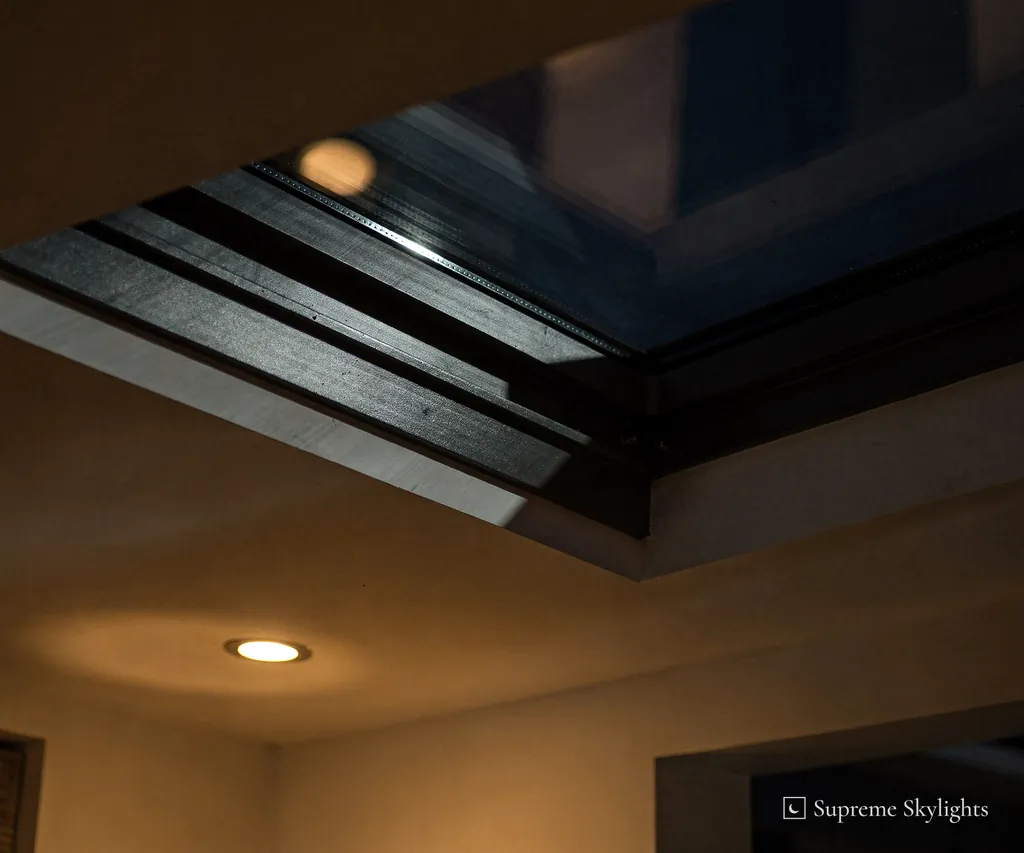
Dusk is when the shape tells. The sky goes from pale to dark, and the sloping glass loses its daytime brightness and starts to repeat the room: the table, the lamps, whoever is sitting there. Sitting in a lit room under black glass is a different experience from sitting under a daylight roof, and it is worth knowing before you choose a lantern over a flat unit.
Compare it with a flat rooflight, which sits lower and shows less of itself from outside. The two are set side by side on the page about a lantern against flat rooflight, with the differences listed.
Whichever you choose, ask about the lining. The plasterboard that finishes the inside of the opening is what you look at every day, and its shape and depth are agreed before the order, not after it.
Overnight under a rooflight
Condensation, vents and the first light of the morning.
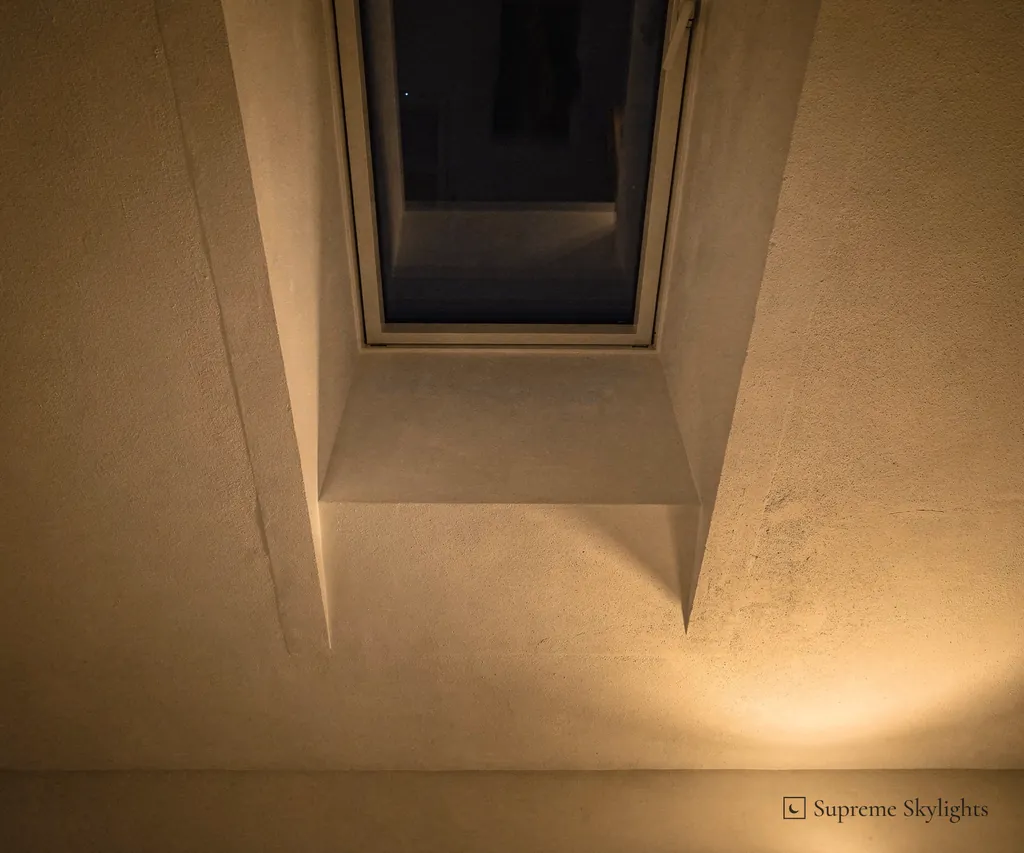
Glass in a roof is exposed to the sky. On a cold, clear night it can be the coldest surface in the room, and warm indoor air that reaches it can leave moisture behind. That is what people mean by night-time condensation, and it shows in the morning as droplets on the pane or damp on the lining of the reveal.
A bathroom, a kitchen and a room that is dried by a radiator all put moisture into the air, so the question is where it goes. A rooflight that opens gives it a way out, and an extractor or a vent gives it another. When an old window is replaced, Approved Document F (Wales) wants the ventilation to end up no worse than it was, and a window that came with trickle vents should be succeeded by one with vents that can be controlled by the occupant or that act automatically.
The fabric around the glass matters too. A reveal lined square and tight can give moisture fewer places to settle. A ragged one can give it plenty. The lining is worth discussing at the survey, because it is decided before the work starts.
Then there is first light. Early light is a bedroom question. Over a bed, a roof window can be chosen together with a blackout blind; over a landing or a kitchen, early light is welcome.
Cleaning is a related question for glass that is out of reach. Pilkington lists roof-lights among the uses for its Activ self-cleaning coating, which uses daylight to loosen dirt so that rain can wash it off. It is one more option to raise at the survey when a rooflight will sit above a stair or a worktop that nobody can get at easily. An electric opening rooflight belongs in the same conversation, since it can be opened from a switch or handset instead of a pole.
Rooflight overnight
- Coldest surface
- Often the glass itself
- Moisture goes
- Through an opening unit, a vent or a fan
- Reveal
- Square and tightly lined
- Over a bed
- Roof window and blackout blind
- Paperwork
- Building Regulations notification handled where notifiable
What people ask about Undy
Does Magor's conservation area affect houses in Undy?
Monmouthshire publishes an appraisal for Magor. The Welsh rule catches only houses inside a conservation area boundary, so the position for any Undy address comes from the council, and the rule is laid out in the planning guide's Wales section.
Which energy figure applies to a new rooflight?
Approved Document L (Wales) sets 2.2 W/m²K as the U-value a new or replacement rooflight should meet when it goes into an existing home. It is guidance, written as a should, and the figure for a roof window is 1.4 W/m²K or Window Energy Rating band B. Ask for the figure for the unit as it will be built, because that is the number to hold up against the guidance.
Can a lantern go on an old flat roof without planning permission?
Normally not under the Welsh permitted development rules, because a lantern stands well above the roof. We confirm the position with Monmouthshire County Council at the survey.
Who gives listed building consent near Undy?
Monmouthshire County Council, as the local planning authority. It is required for work that would affect a listed building's character. Cadw publishes each listed building record in Cof Cymru.
Do you cover Undy and its neighbours?
Undy is eastward of Newport, 10 miles along the road, and there are separate pages for Rogiet and Caldicot nearby. No price is given before the free survey, and after it comes a fixed written quote.
Where do I send the address for a visit?
The survey form takes it, or send it on WhatsApp to 07880 284133, or by email to info@supremeskylightsnewport.co.uk. Add a line about the room, and a note of anything unusual about the roof.

Book your free survey
10-year workmanship guarantee.
Building Control notification handled where notifiable.