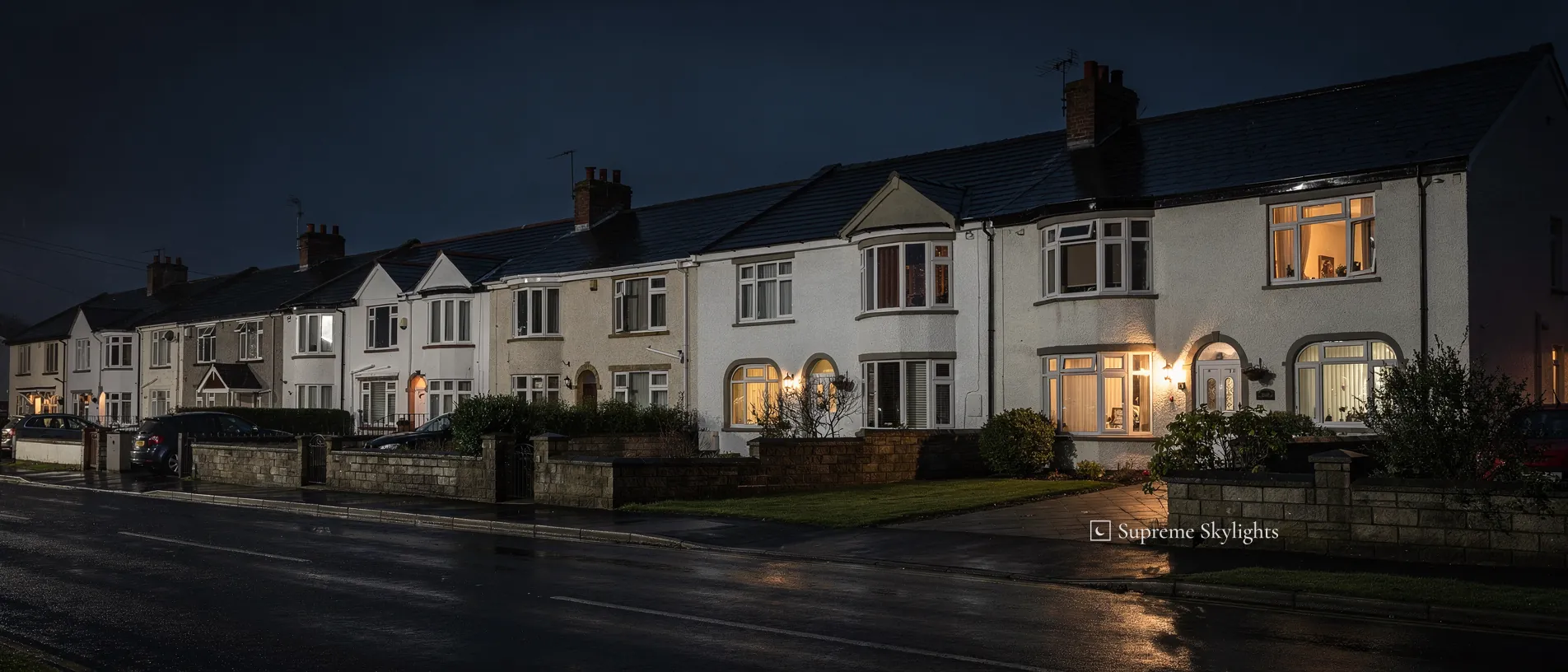
Rhondda Cynon Taf, 22 road miles from Newport heading west
Rooflights and skylights for Pontyclun homes
- 10-year workmanship guarantee
- We handle the Building Control notification where notifiable
A bridge over the Clun and the roofs around it
The name means 'bridge over the River Clun'. The Clun is a tributary of the River Ely and runs through the town, and a bridge crosses the Afon Clun just above the point where it joins the Ely. Pontyclun railway station sits on the South Wales Main Line. When the South Wales Railway arrived in 1851, a 20-acre farm of four or five households began turning into a Victorian industrial town. The Coedcae Colliery, first listed in 1856, and the Bute iron ore mine, which opened in October 1852, caused the population growth.
Roofs differ from one street to the next, so we begin with the age and type of the house. Slate and clay tile are common on older terraces, concrete tile on many mid-century semis, and flat membranes on extensions. At the survey we look at what covers the roof, how steeply it slopes and what framing lies over the room in question, and each roof is judged separately.
| Kind of house | Roof over the room | Glass worth discussing |
|---|---|---|
| Victorian or Edwardian terrace | Pitched slate or tile, often with a lower rear part | A roof window on the main slope; a flat rooflight on the rear part |
| Interwar or post-war semi | Pitched tile over a loft that can be boarded | Two roof windows and blackout blinds for the loft bedroom |
| Single-storey rear extension | Flat, with joists below | A flat rooflight, or a lantern where the ceiling has height to spare |
| Wide kitchen-diner far from the garden doors | Flat or low-pitched, deep in the plan | A roof lantern over the dining end |
Where glass earns its place on Pontyclun roofs


11:00
Rhondda Cynon Taf and the rules in Wales
Pontyclun's planning decisions rest with Rhondda Cynon Taf County Borough Council. In Wales a rooflight can go into a house roof as permitted development, within limits and with conditions attached, and the Welsh section of our planning guide lays them out. Flats and maisonettes sit outside householder permitted development altogether.
Rights can be taken away. A council may make an Article 4 direction, and a condition attached to a house's original permission may do the same, so a newer house is worth a quick read of its planning history.
Listed buildings are a separate matter. If the work would affect a listed house's special character, listed building consent is needed, and the council deals with that application.
12:00
Around the Clun and the Ely
Sleeping under the slope in June
Roof windows, blackout blinds and an early sky.
June skies start to brighten at an hour most people would rather ignore. In a loft bedroom the roof window points at open sky, with no wall or hedge in the way, so the first grey light lands on the pillow.
A blackout blind is the plain answer. Which blind goes on which window is settled at the survey, along with whether you also want a lighter fabric for winter mornings, when a room under the roof wants all the daylight it can get. One window and one blind are being asked to behave differently in December and in June, which is a good reason to choose them together.
Heat comes into it as well. The room sits directly beneath the roof covering, and after a still, warm day it can hold on to the warmth well into the evening. A roof window that opens lets warm air out and fresh air in. If the handle would sit above comfortable reach, a motorised version can take its orders from a wall switch or a remote, and the electric opening rooflights hub covers the options.
Overnight the glass above a bed turns into a dark panel with the bedside lamp mirrored in it. Drawing the blind hides the panel along with the sunrise.
Replacing is slightly different from adding. Approved Document F (Wales) addresses it: if the window being removed was fitted with trickle vents, its replacement should carry vents no smaller than the originals, which the occupant or an automatic control can operate. That is worth knowing before a new sash is chosen, because the vent is part of the window. It is also worth deciding who sleeps in the room and when, since a child's bedroom and a spare room are used at different hours.
Size is the next job. VELUX gives every roof window a code, stamped on a type sign along the top edge of the sash. It shows when the window is open, and windows made after 1968 carry one. Read the code off the sign and you have the window's width and height, so a photograph of it saves us a step. The company's roof windows come in standard sizes.
A new rooflight in Wales will generally need approval under the Building Regulations, and where the job is notifiable the notification is ours to deal with, through local authority building control or a registered building control approver. Swapping an old window for a matching one is also building work. Where an old window is simply being exchanged, our skylight replacement guide covers the difference.
One June morning above the bed
- 05:00First lightThe sky pales, and a bare window lets it straight in.
- 06:30Full dayA blackout blind keeps the room dim.
- 08:00UpThe blind goes up and the sash opens a little for air.
A flat roof over the back kitchen
Flat rooflights and lanterns on a wet afternoon.
Is the far end of your kitchen dim by half past two? A single-storey extension can leave the old back wall, and its window, buried in the middle of the house. The worktop furthest from the garden doors ends up in shade whatever the sky is doing.
Glass overhead puts daylight back. A flat rooflight sits on a raised upstand and holds a low profile, which is handy where bedroom windows upstairs look down on the extension. A roof lantern rises higher, its glass pitched like a small roof, and it gives the ceiling beneath it some shape. Our comparison of a lantern against a flat rooflight puts them side by side.
A wet afternoon shows what the glass does besides admit light. VELUX lists reduced rain noise among the glazing options for its roof windows, though what you can have varies with the window and glazing variant. Pilkington counts roof glazing among the places its Activ coating can be used: daylight loosens the dirt, then rain rinses it away. Treat both as questions for the survey, not features that every rooflight carries. Neither is needed to make the room brighter, and neither changes the position of the opening.
Water has to leave the roof as well. For its flat glass rooflights, Rainclear recommends a kerb sloping by at least 5 degrees so that water does not pool. The upstand itself is built to the maker's details.
A lantern put onto an existing flat roof would normally fall outside permitted development, which means it would need planning permission, and you can check the position in the Wales part of the planning guide. On an extension that has yet to be built, the lantern question goes to the council before anything is ordered.
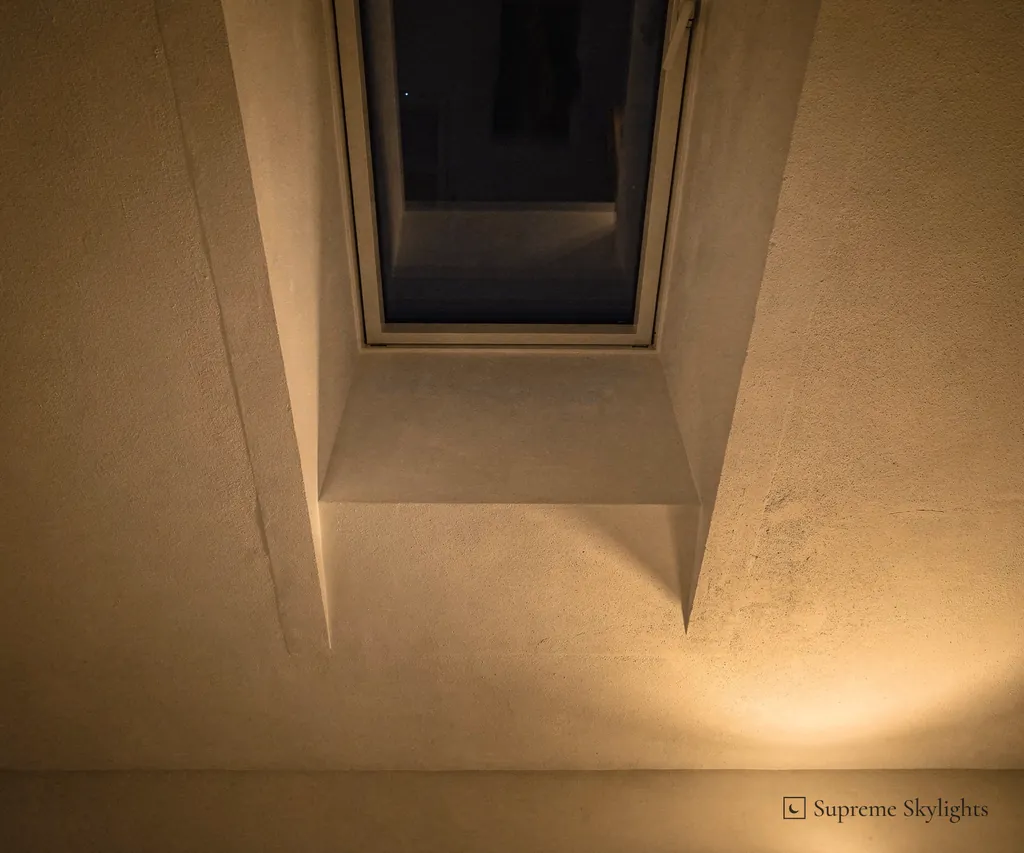
Steam from the hob can settle on the glass overnight, since it is often the chilliest surface around. Venting the cooker hood outdoors cuts it down, and a rooflight with an opening sash lets the rest out. The lining around the opening also shapes how daylight falls into the room, so it is worth talking through at the survey and not leaving to the plasterer.
Start with the room itself. How deep it runs from the garden doors, how high the ceiling stands and what the windows next door can see from above all point towards one product or the other, and they are quicker to judge standing in the room than from a plan.
| Flat rooflight | Roof lantern | |
|---|---|---|
| Shape from outside | Low, on an upstand | Taller, with pitched glass |
| Ceiling below | A clean opening | A shaped well with more height |
| Onto an existing flat roof | Can fit within householder limits | Normally needs planning permission |
The stairs in the short days
Sun tunnels for a landing the winter sun never reaches.
Look up before you look down. A sun tunnel needs a clear path from roof to ceiling, and in a loft that path has to get past purlins, a cold-water tank, cables and stored boxes. Straight and short is the easy case. Anything with a bend is a question for the product and the room.
By ten to five on a December afternoon the daylight has gone. A sun tunnel carries daylight and nothing else, so on the stairs it earns its keep in the morning and at midday and falls quiet when the sky does. The diffuser in the ceiling becomes a pale disc, and the landing light takes over.
The sun tunnel suits the dark centre of a house: stairwells, inner hallways, walk-in wardrobes and small cloakrooms. Each is walled in on every side, and a modest amount of daylight changes how the space gets used.
Bedrooms are different. Nothing on a sun tunnel shuts out a June sunrise in a simple way, so for sleeping rooms, fit a roof window and add blackout for the bed. Our page on rigid or flexible tubes compares the two kinds for the run through the loft.
Outside, the covering can decide the flashing, so we note the covering (slate, clay tile or concrete tile) and choose the slope that sees the most sky. Indoors, the diffuser is placed to light the stairs and the doorways, which need not be the dead centre of the ceiling.
The sun tunnels page has the full picture, and the survey settles whether the loft above your landing allows a clear run.
Questions from Pontyclun
Is Pontyclun somewhere you work?
It is. The drive from Newport, heading west, is 22 road miles, and the survey costs nothing. Talbot Green and Llantrisant share the same council and have pages of their own.
Which council handles planning for a Pontyclun house?
Rhondda Cynon Taf County Borough Council. A rooflight on a house can often be permitted development in Wales, and the limits are in our Welsh planning guide.
How do I read the size of my VELUX window?
Open the sash and look along the top for the metal type sign. That size code gives you the width and the height. VELUX's own table lists MK04 as 78 x 98 cm and UK04 as 134 x 98 cm, for example.
Does a new rooflight need approval under the Building Regulations?
Generally, yes. Forming the hole usually calls for changes to the roof's structure, and that roof then needs strength enough for the extra weight, or strengthening. The unit also has to be energy efficient, and fire performance matters near a boundary. Where the job is notifiable, the notification is ours.
Can a lantern go onto my existing flat roof?
It would normally need planning permission, because a lantern set onto a flat roof that is there now normally falls outside permitted development. The planning guide for Wales explains the rules, and the council has the final word.
What is the quickest way to book?
Use the survey form. WhatsApp (07880 284133) and email (info@supremeskylightsnewport.co.uk) work as well; tell us the address and which room needs the light.

Book your free survey
10-year workmanship guarantee.
Building Control notification handled where notifiable.