
Torfaen's town, a 9-mile road journey north from Newport
Rooflight and skylight installation in Pontypool
- 10-year workmanship guarantee
- We handle the Building Control notification where notifiable
Forges in the 1570s, late Victorian streets after
Pontypool (the Welsh name is Pont-y-pŵl) is a town and the administrative centre of the county borough of Torfaen, within the historic boundaries of Monmouthshire. The drive from Newport covers 9 miles and heads north. The Welsh name comes from a bridge associated with a pool in the Afon Lwyd.
Industry came early. Richard Hanbury, an entrepreneur from Worcestershire, developed interests in the Pontypool area during the 1570s, acquiring and developing forges and furnaces, and the town later kept a niche in the metallurgical market by producing specialist tinplate.
The Afon Lwyd valley offered coal, iron ore, charcoal and waterpower for making iron, and dwellings were built along the river to house the workforce. By the middle of the eighteenth century a small town had developed, and Pontypool carried on growing through the nineteenth century, with many new houses and buildings going up in the late Victorian period. Houses from a period like that are often roofed in slate, while later houses have their own roof types. Whatever the age of the house, the visit begins at the roof itself: its material, its steepness and the room that lies beneath it, since all three narrow the choice of glass.
| Property | Covering above | Where glass may go |
|---|---|---|
| Late Victorian house | Often slate on a steep pitch, with a rear return | A roof window set in the main slope; on the return, a flat unit |
| House inside the town-centre conservation area | The original roof slope, where a new rooflight needs an application | A conservation rooflight, planned with the council first |
| Mid-century semi | Tile over a loft that has room to work in | A roof window for a loft bedroom |
| Rear kitchen extension | A flat roof built over joists | A flat rooflight over the worktop or the table |
Three products to weigh for a Pontypool house

11:00
Torfaen's rules, and a town-centre conservation area
Torfaen County Borough Council takes the planning decisions in Pontypool, and its list of conservation areas includes Pontypool Town Centre. In Wales, a rooflight added to a house inside a conservation area is not permitted development, so an application is needed; the reasoning sits in our planning guide for Wales. Only houses inside the boundary are caught, and a boundary can cut through a town, so the council's conservation area page is where to look.
Elsewhere in the town, the same guide covers the limits on a house, and a council direction, or a requirement set when the house first got permission, can alter the position. Flats and maisonettes are outside householder rights from the start. If you are unsure which applies, Torfaen's planning team is the body to ask, and a Lawful Development Certificate records the answer in writing.
Listed building consent is applied for through Torfaen, and it is needed where work would affect a listed building's character. Cadw recommends what is listed and the Welsh Ministers compile the list. Where the work is notifiable, we handle the Building Regulations notification with local authority building control or a registered building control approver.
12:00
Close to Pontypool
What changes inside a conservation area?
Slate roofs, listed buildings and the application route.
Pont-y-pŵl takes its name from a bridge associated with a pool in the Afon Lwyd. Torfaen lists Pontypool Town Centre among its conservation areas, and inside that boundary the rooflight question changes.
The change is easy to state. A house inside the boundary cannot add a rooflight as permitted development, so the owner applies to the council. The same house, just outside the boundary, is treated differently. That is why the first job on a Pontypool visit is to settle where the address falls, using Torfaen's own conservation area page and, if there is doubt, the council's planning team.
A listed house adds another layer. Listed building consent covers inside work as well as outside, including historic fixtures and details, and even minor work can need it. Cadw notes that replacing traditional windows with uPVC on a listed building will not normally be acceptable. The consent comes from the council. Starting without it can be a criminal offence, so the question is asked before an order is placed.
When an application is the route, the product matters. The type is described on our conservation rooflight page, which is worth reading before an application is made. Cadw also publishes each listed building record in Cof Cymru, so a quick look there tells you whether your house is on the list at all.
Outside the conservation area the questions are the usual ones: the covering, the timbers, the room. Energy rules treat old buildings a little differently. Approved Document L (Wales) allows a fallback for a replacement window or roof window on a home of architectural or historic interest that cannot reach 1.4 W/m²K: 1.2 W/m²K at the centre of the pane, or low-e secondary glazing. The fallback never applies to rooflights or to new openings. The planning guide holds the Welsh rules, and the survey is free whichever side of the line the house sits.
A back bathroom on a terrace
Roof windows where the room is small and the air is wet.
Look first at what stands beside the window position. In a terrace, the back bathroom can sit under a rear slope or a lean-to, close to the windows of the next house, and that fact shapes the choice of glass, the blind and the way the sash opens. A bathroom blind is there for privacy and for damp air, so it is a different brief from the blackout blind that goes over a bed.
Steam is the working problem. A bathroom puts moisture into the air quickly, and a roof window is a cold surface for it to land on, so an opening window and an extractor fan can both help. A window that is hard to reach is a window that stays shut, which is why the controls are discussed alongside the glass choice.
Privacy is the other half. A lit bathroom at night can be seen into from a higher window next door, and the room reads as a bright box from outside. A blind takes care of that, and the blind for a damp room is chosen with the window.
Fitting a roof window into a bathroom is building work, since roof windows are controlled fittings, and a new opening will generally need Building Regulations approval. A like-for-like replacement is building work too. Approved Document F (Wales) looks at ventilation when a window is swapped, and Approved Document L (Wales) says a new or replacement roof window should meet 1.4 W/m²K or Window Energy Rating band B.
The roof windows section covers sizes, opening types and blinds. Three answers help most: whether the window goes over the bath or the basin, who sleeps in the room next door, and how the room is aired today.
Roof window, back bathroom
- Sits in
- The slope of a rear roof or lean-to
- Wet room needs
- An opening sash, and an extractor fan
- Privacy
- A blind chosen for damp air
- Reach
- By hand or by motor, settled with the window
- Paperwork
- Building Regulations notification handled where notifiable
An autumn evening over the kitchen
Flat rooflights at the back of the house.
Autumn evenings arrive early, and a kitchen extension shows it at once. The daylight that filled the room at midday is gone by teatime, and a flat rooflight over the worktop turns from the brightest thing in the room to a dark square.
A flat rooflight is a glazed unit sitting on a kerb or upstand, out of plane with the roof, and Approved Document L (Wales) says a rooflight in an existing home should have a U-value no worse than 2.2 W/m²K. The figure is based on the unit's whole developed surface, which is often bigger than the hole it covers. On the slope of the kerb, Rainclear advises a minimum of 5 degrees for its own flat glass rooflights, to reduce pooling. That is one maker's advice about its product, not a rule for every rooflight.
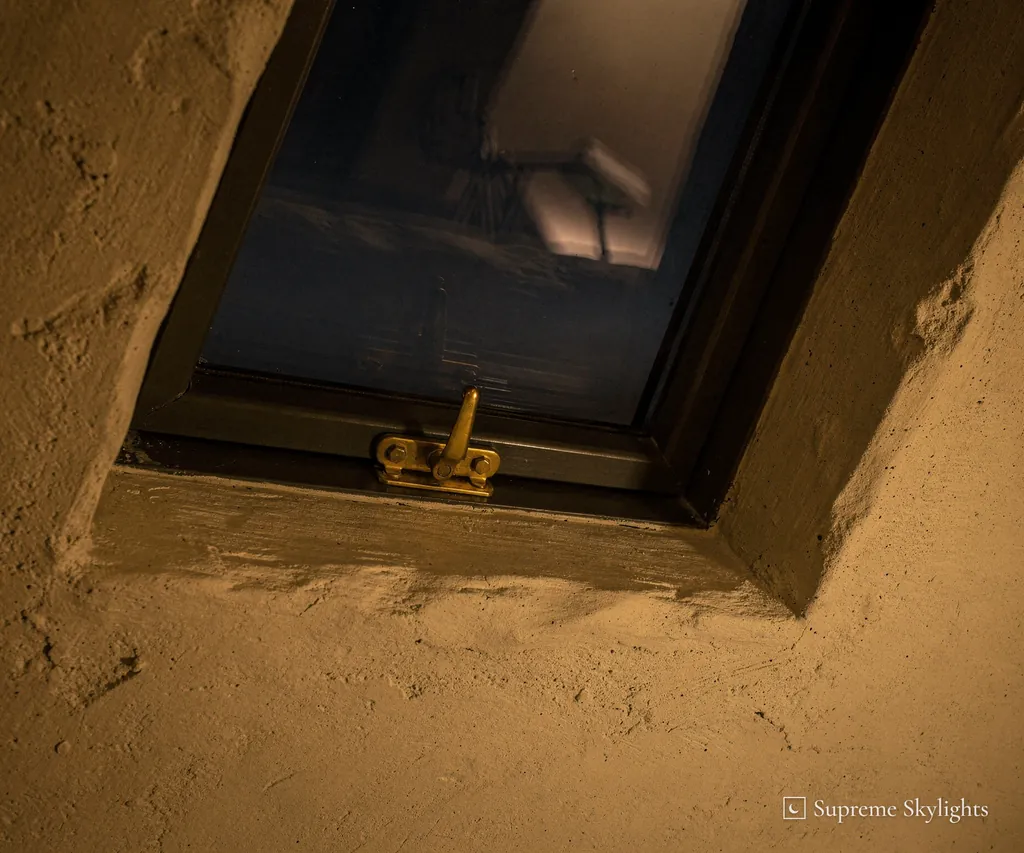
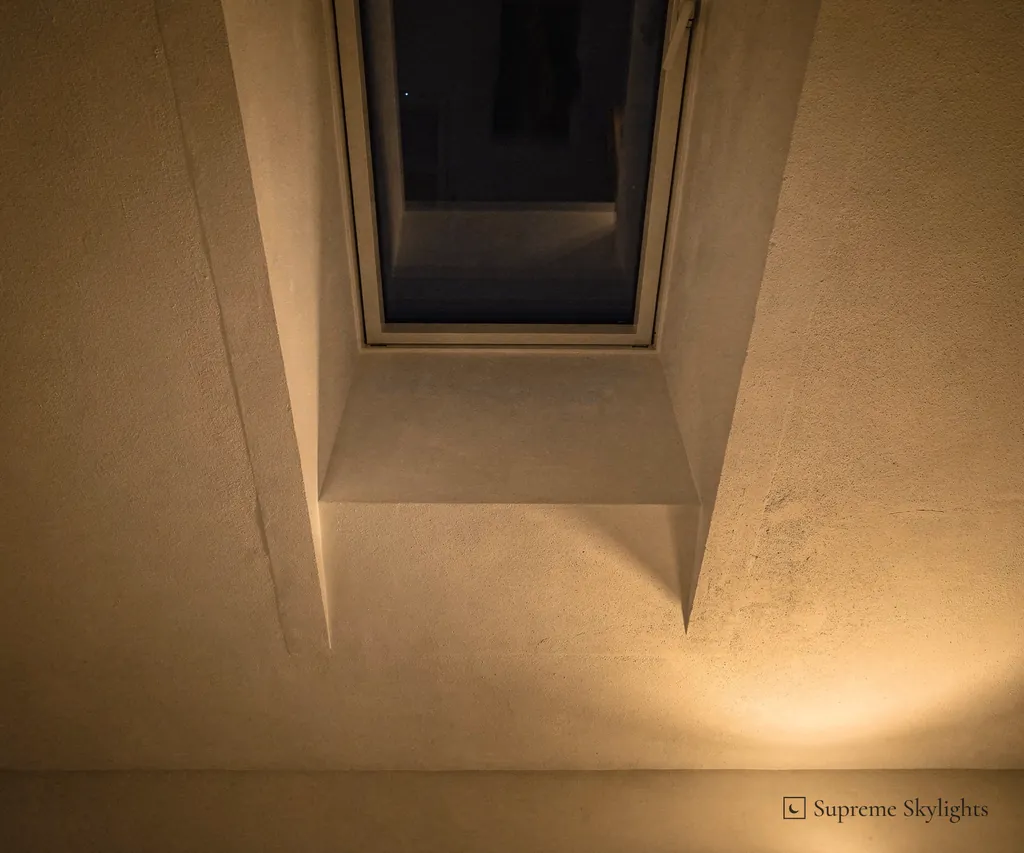
The late hours are when the glass looks its most surprising. On a cold night it can collect moisture first, because glass may be the coldest surface in the kitchen, and an opening vent can help. With the room lights on and the sky black, the rooflight turns into a mirror, and the worktop, the extractor and anyone washing up are doubled in it. Steam from the hob can mist it, and a rooflight that opens can help clear it. Fixed against opening is the choice that needs thought, and the guide to flat rooflights that are fixed or opening compares the pair.
The lining decides how it looks. A plain, square reveal gives an even dark panel overhead, whereas a messy one picks up every lamp. We settle the depth and the finish at the survey, so that the evening view is no surprise. It is also the moment to ask about the controls, because glass above a worktop is out of reach, and a switch or a handset is easier to live with than a pole.
Planning for a rooflight on a flat extension roof follows the same Welsh guide as everything else. Our page on flat rooflights and planning sets out the usual questions.
Pontypool and the Torfaen rules, briefly
Is the town centre the only part of Pontypool that needs a check?
No. Pontypool Town Centre is among the conservation areas Torfaen lists, and the council's page is where to check any address. Houses outside a conservation area follow the ordinary Welsh rules, with the council's directions and any condition on the house's first permission still to be checked.
Who deals with the Building Regulations side?
We do. Where the work is notifiable, we notify local authority building control or a registered building control approver, and a new opening in a roof will generally need approval.
What suits a late Victorian terrace with a back bathroom?
A roof window set into the rear slope can suit it, with a blind and an extractor to deal with steam. The roof covering and the room underneath are looked at on the survey.
Where can I find out whether my house is listed?
Cadw publishes every listed building record in Cof Cymru. Listed building consent is applied for through Torfaen County Borough Council, and it covers work that would affect the building's character.
How far is Pontypool from you?
From Newport, Pontypool is a 9-mile drive north. It is the administrative centre of the county borough of Torfaen. No price is given until the free survey has been done, and the quote after it is a fixed written quote. Each job starts with a postcode and a description of the room.
Which details help when I book?
The survey form is one way in; WhatsApp (07880 284133) and info@supremeskylightsnewport.co.uk are others. Give the address, the room and a note of whether the house is listed or has been altered at the back.

Book your free survey
10-year workmanship guarantee.
Building Control notification handled where notifiable.